Categories
Recording

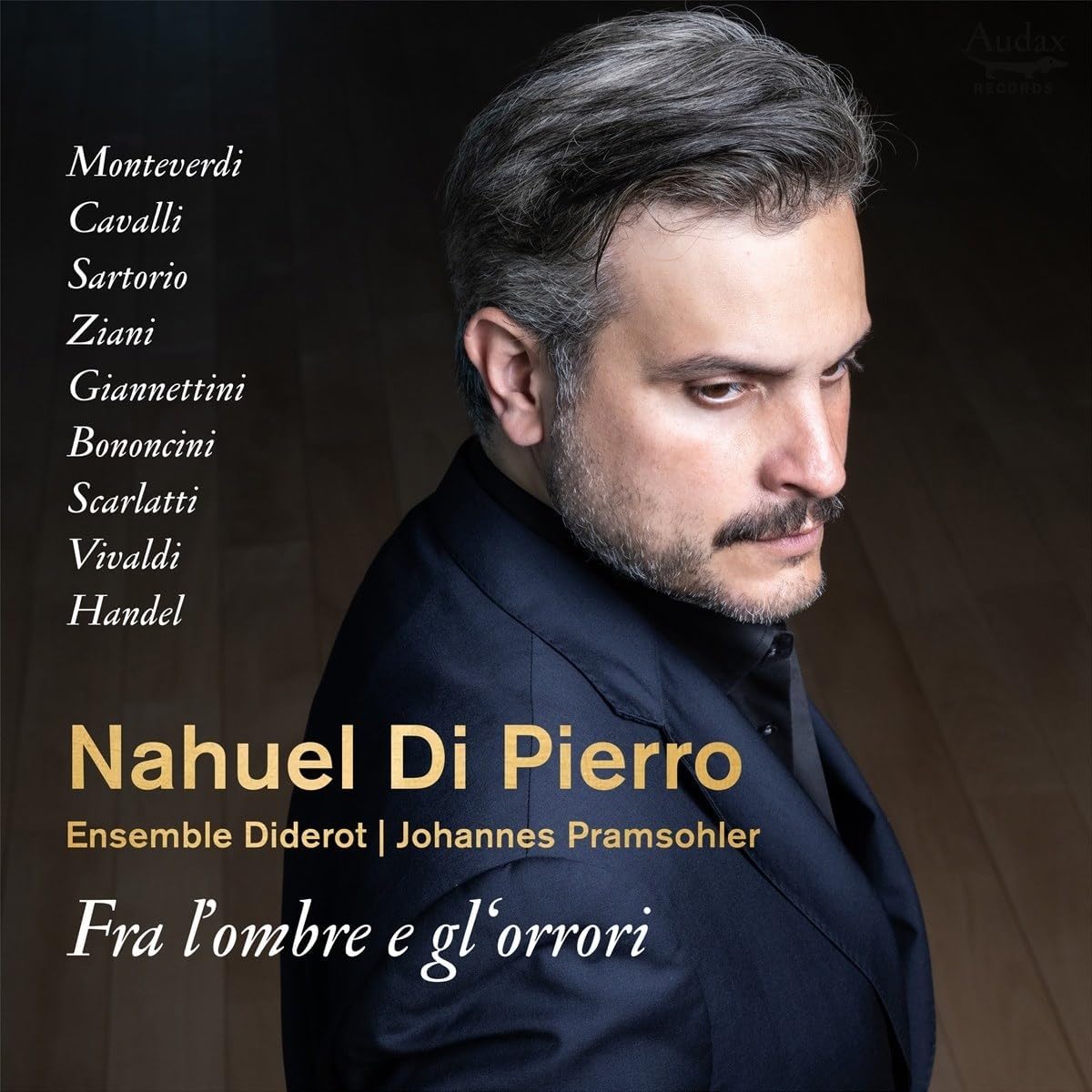
Fra l’ombre e gl’orrori
Nahuel Di Pierro bass, Ensemble Diderot, directed by Johannes Pramsohler
74:02
Audax Records ADX 11210

This CD traces music written for the solo bass voice from the compositions of Monteverdi to Handel. While the obvious stars of the Baroque opera scene were mainly the sopranos and castrati, as the CD notes concede, in selecting the music for this programme cleverly, conductor Johannes Pramsohler and bass Nahuel Di Pierro bring the Baroque bass convincingly out of the shadows. Di Pierro has a beautifully rich voice and sings with technical authority, dramatising the music extremely effectively. As we proceed through history, the instrumental ensemble expands appropriately from the string ensembles needed for Rossi, Monteverdi, Cavalli and Sartorio, acquiring brass, woodwind and percussion supplements for Marc’Antonio Ziani, Antonio Giannettini, Giovanni Bononcini, Alessandro Scarlatti and Antonio Vivaldi before we get to Handel. While several arias are striking for their flamboyant martial flavours, what emerges is the huge range of moods the Baroque bass singer is asked to represent. He is as often a lover or a lamentable victim as he is a hero, and Di Pierro captures this full kaleidoscope of moods in his marvellously varied vocal tones. The singing of three supplementary vocalists (Nicholas Scott, Guillaume Gutierrez and Nicolas Brooymans) in the ensemble “Amici, è giunta l’hora” from Monteverdi’s L’Incoronazione di Poppea is superlative, and the orchestral playing throughout is beautifully concise and supportive. Incidentally, in addition to directing, Johannes Pramsohler joins Roldán Bernabé in some stunning obbligato violin duetting, particularly in the magnificent aria “Occhi belli”, occhi possenti from Bononcini’s Il ritorno di Giulio Cesare, one of the many highlights of this excellent disc.

D. James Ross

Categories
Recording

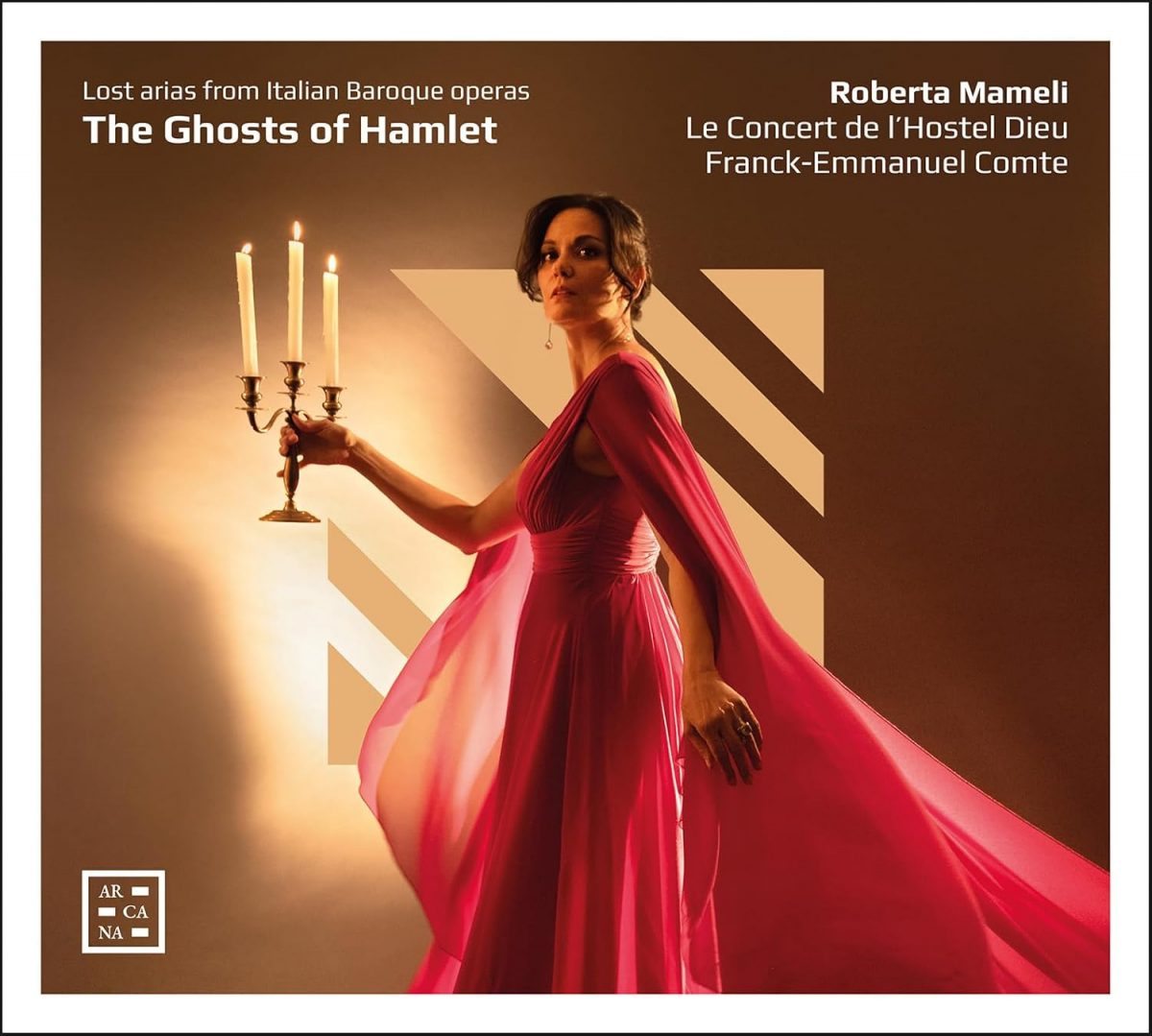
The Ghosts of Hamlet

Lost arias from Italian Baroque operas
Roberta Mameli, Le Concert de l’Hostel Dieu, Franck-Emmanuel Comte
68:04
Arcana A574

Who knew there were so many Italian Baroque operatic representations of Ambleto? Composers such as Giuseppe Carcani, Francesco Gasparini and Domenico Scarlatti turned their hand to operas based on Hamlet, albeit not the iconic play by Shakespeare, but the earlier story contained in the 12th-century Gesta Danorum picked up and adapted by the Venetian librettist Apostolo Zeno. In addition to arias from these now almost entirely forgotten Hamlets, we have a pasticcio version of arias by Carlo Francesco Pollarolo and Handel, the latter a textual rewriting of “Tu ben degno” from Agrippina to press it into service as a Hamlet aria. These are augmented by a stormy D-minor sinfonia by Scarlatti, which, given the composer’s interest in the Hamlet narrative, may be seen to reflect the mercurial moods of the Danish prince. Produced in the first half of the 18th century in Venice and Rome, this wealth of Hamletiana, augmented by the London pasticcios, is not without merit – these were competitive times in musically dynamic milieux in which almost nothing mediocre saw the light of day, and these tuneful arias, dramatically sung by Roberta Mameli are a testimony to the quality of the many operas of the time which have fallen into neglect along with their composers. Le Concert de l’Hostel Dieu, an ensemble new to me, plays with an admirable precision and musicality, avoiding the extremes of articulation which have become the fashion with other specialist Baroque ensembles, and under the direction of their founder Frank-Emmanuel Comte they produce authoritative accounts of this unfamiliar material. Roberta Mameli is a technically assured Baroque specialist who invests the music with a memorable passion.

D. James Ross

Categories
Recording

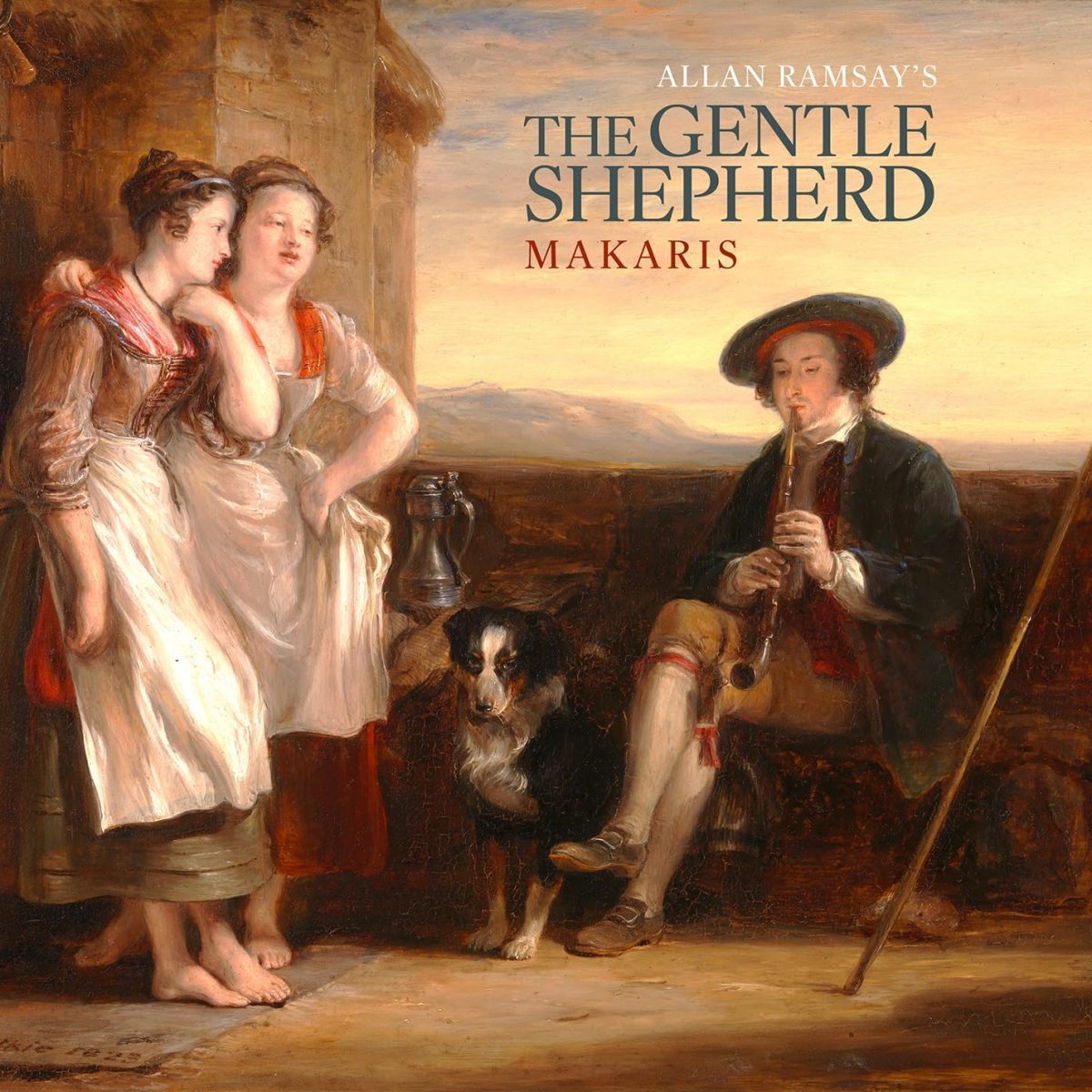
The Gentle Shepherd

Makaris
71:23
Olde Focus Recordings FCR924

Alan Ramsay’s pastoral opera of 1725 is a remarkable piece which I feel has never received the attention or status that it deserves. Written/compiled three years before the iconic Beggar’s Opera, it essentially kicked off the whole ballad opera vogue of the early 18th century and remains one of the finest examples of the genre. Borrowing from a wide range of traditional and ‘classical’ sources of the time, Ramsay has produced a work with genuine folky charm and elegance. The text itself, in literary Scots, is linguistically accomplished, with a wicked ironic squint, which it bequeathed to the later ballad operas. The ensemble Makaris takes a very creative approach to the music, with imaginative use of a variety of early/traditional instruments. Amongst them is the stock-and-horn, a mainly Scottish woodwind instrument, which came into prominence in the 18th century, and has an oboe-like body ending in a cow-horn bell. It has a free-vibrating single reed, making it an early member of the clarinet family, and it has a pleasant and mellow tone. It appears as a prop in many 18th-century engravings and paintings of Scottish rural scenes, including some depictions of Ramsay’s Gentle Shepherd. In this recording, lively and convincing accounts of the 21 songs are peppered with six well-chosen instrumental interludes selected from 18th-century sources. Just occasionally, a couple of the singers struggle with the upper register of the implausibly extensive tessitura of these mock rustic pieces – I have often wondered if this suggests that originally a semi-spoken delivery might have been employed by 18th-century actresses? The original ballad opera has an extensive rhyming text and a cast of eleven – the present recording rationalises a few of the characters and features radio broadcaster David ‘Jock’ Nicol as narrator, who sets scenes and links the narrative. Talking over some of the music and sounding very much like an electronic add-on, I found this aspect less than successful. A semi-staged performance of the complete ballad opera some years ago directed by David McGuinness with his Concerto Caledonia and a full cast demonstrated the merits of the complete work, and perhaps like The Beggar’s Opera, this important piece deserves to be committed to CD in its entirety. McGuinness went on to produce an authoritative edition of the piece and to record all the songs. In the meantime, this sympathetic and entertaining account of the songs by Makaris speaks powerfully for more attention to be paid to this neglected work – and perhaps it is overdue another production!

D. James Ross

Categories
Recording

Charpentier: Les Arts Florissants

Dallas Bach Society, directed by James Richman
65:35
Rubicon RCD 1128

The cover illustration of this issue and listing of the New York Baroque Dance Company among the artists enticingly suggests this might be a DVD rather than CD. The impression is enhanced by a passing observation made in his somewhat bizarre notes by Dallas Bach Society director James Richman, but visits to Rubicon’s website and YouTube bring no further suggestion that there is a film. So quite where a Baroque dance company fits into an audio recording must for now remain a mystery.*

Like a number of works such as Racine and Lully’s Idylle sur la paix, Les Arts Florissants (H.487) owes its existence to the Ratisbon Truce of 1684, the signing of which brought an end to war between Louis XIV’s France and the Holy Roman Empire and Spain. It was written for Charpentier’s long-term patron Madam de Guise, and was doubtlessly performed at her hôtel along with another celebratory work, the brief La Couronne de Fleurs (H.486). A charming conceit, Les Arts brings together the various arts to celebrate the king’s victories in their own brief contributions, seconded by a Chorus of Warriors relieved at the cessation of battle. Meanwhile, Discord still clamours for the return of war, a sentiment opposed and overcome by Peace (La Paix). The five scenes are punctuated by dance, as would be expected in a French work of this kind.

It is probably fair to say that Dallas is not the first place you’d associate with French Baroque music, but James Richman here directs an appealing performance particular notable for the contribution of the members of the Dallas Bach Society. In keeping with the original performing circumstances the instrumental forces are small, just pairs of flutes and violins with cello, gamba, theorbo and harpsichord continuo. The playing throughout is of high technical quality, only just missing out on the final degree of idiomatic rhythmic lift. The eight vocalists are also commendable in their grasp of style, but it is unfortunate that a resonant church acoustic has blunted the already poor diction of most of them, an honourable exception being stand-out soprano Haley Sicking, who is also better with ornamentation than her colleagues. Indeed, with her fresh but attractively rounded soprano, Sicking’s La Paix brings constant pleasure.

It would have been good to add the companion La Couronne, as does the larger-scale performance on Versailles Spectacles, but here we have instead a nine-movement Sonata a 8 (H.548) scored for the same forces as those employed in Les Arts Florissants. Not a perfect CD, but one that shows that French Baroque musical art can indeed flourish far from home.

Brian Robins

* The answer may lurk somewhere on their website

Categories
Recording

Handel: Serse

Emily D’Angelo Serse, Paula Murrihy Arsamene, Daniela Mack Amastre, Lucy Crowe Romilda, Mary Bevan Atalanta, Neal Davies Ariodate, William Dazeley Elviro, English Concert, Harry Bicket
172:38 (3 CDs in a card triptych)
Linn CKD709

One of Handel’s last operas written against the backdrop of the collapse of the London operatic scene, which precipitated the composer’s inspired switch to the composition of oratorios, Serse fell victim to its circumstances receiving only five performances in Handel’s lifetime. If this reflected the tumultuous finances of the company presenting it and perhaps a perceptible decline in performance standards as well as the changing taste of the London public, it certainly had little to do with the quality of the music Handel had composed. Remembered now primarily for Serse’s opening aria, the exquisite Ombra mai fu, this is a work like so many others composed by the mature Handel, rich in originality and masterly music. Having mentioned this opening aria, I should probably address my main reservation about this account – the role of Serse, taken by the irascible and temperamental castrato Caffarelli in the original run, is here sung by the mezzo-soprano Emily D’Angelo. While she sings very expressively and musically, the decision not to use one of the excellent male alto singers currently available is baffling and changes the character of the eponymous hero. No reference is made to this odd decision in the performance notes, but I’m afraid it had a major effect on my enjoyment of this recording. Having said that, the singing from the first-rate line-up of soloists and the chorus is wonderfully expressive, while the orchestral playing is superlatively supportive, responsive and beautifully crafted – particular mention should be made of the orchestral trumpet playing, which is not just punchy punctuation but beautifully phrased and tastefully lyrical. Harry Bicket has a wonderful way with Baroque music, and his reading of this rich score is exemplary. The revival of the fortunes of Handel’s operas is something which has happened largely in my own lifetime, but this recording of Serse emphasises that this process has still some way to run. I was ashamed and appalled that the bulk of this excellent music was completely unknown to me – there is simply so much excellent Handel lurking in the less familiar operas and oratorios that complete recordings such as this are extremely valuable. David Vickers’ fascinating programme note makes the unexpected and valuable observation that a connecting line can be drawn between these late operas of Handel and the late-18th-century opera buffa of Mozart and his contemporaries. In the middle of the physical and mental breakdown which accompanied the collapse of Handel’s operatic aspirations, it would have been some consolation to him to know that the opera condemned to such a short run under his direction would go on to enjoy such a fruitful and well-deserved afterlife.

D. James Ross

Categories
Festival-conference

The Innsbruck Early Music Festival and Haydneum Festival, Eszterháza

Although principally undertaken on opera duty, brief successive visits to two European early music festivals also allowed time to take in a chamber music concert in both venues. While the Innsbruck Early Music Festival is well-established and familiar to early music enthusiasts, that at the palace of Eszterháza, Haydn’s principal place of employment for thirty years, is not. Despite a somewhat isolated location that caused Haydn to complain of feeling cut off from the world, I suspect that it being the home of the Haydneum, a centre for early music recently established on the model of the Centre de Musique Baroque de Versailles, will soon result in it having a higher profile.

The first stop was Innsbruck, where the evening after a triumphant first performance of Graupner’s Dido, Königin von Carthago festival-goers were transported up to Ambras Castle, a Renaissance jewel situated above the city. It is there that the majority of the festival’s chamber concerts are given in the spectacular Spanish Hall, that on 26 August being devoted to an intriguing and well-designed programme featuring two composers that at one time or another in the early 18th century might have contributed to making Innsbruck a rival to London. Handel (represented by his Italian cantata Il duello amoroso) seemingly rejected the possibility of employment in Innsbruck, but Mannheim-born Jacob Greber (d. 1731) having failed spectacularly in London did not, becoming Kapellmeister in Innsbruck in 1707. On the evidence of the three cantatas presented, he was a competent if not especially inspired composer, here unkindly cast into the shadows by Handel’s infinitely superior work. In addition to the vocal works, the programme included chamber works featuring recorders by two other German immigrant composers working in London, J C Pepusch and Gottfried Finger.

The vocal performers were the soprano Silvia Frigato, and the French (despite her name) mezzo Mathilde Ortscheidt, a past prizewinner of Innsbruck’s prestigious Cesti Competition and a singer who recently much impressed me in Cimarosa’s L’Olimpiade at Versailles. The instrumental works and support for the singers were provided by members of the Akademie für Alte Musik, Berlin. Without being entirely sure of the reason, the concert came over as a rather flat. Was it perhaps a hang-over from the remarkable Dido of the previous day? Both singers sang well enough, although Frigato’s tone sounded at times shrill and thin. By contrast, Ortscheidt produced a rich tone and some impressive chest notes, but neither appeared sufficiently involved in communicating texts or producing interesting embellishments. Much the same might be said of the instrumental playing, which was as competent as would be expected from such an eminent ensemble but rarely arrested the listening ear.

What was missing was vividly illustrated five days later in the course of the concert given by the Capricornus Consort Basel in the magnificent and beautifully restored Apollo Room in the palace of Eszterháza. The instrumental works included the fine B-flat Concerto (no 2) from van Wassenaer’s set of Concerti Armonico and three works by F X Richter that provided a pertinent reminder of just how excellent a composer he is. The only vocal work in the programme was the sacred cantata Il pianto di Maria by G B Ferrandini, Venetian-born but long employed in Munich. At the conclusion of the text, a scribbled note of mine reads, ‘good on one level but there is another’ and indeed the singing of mezzo Olivia Vermeulen seemed curiously uninvolved for such a searing text, underscored as it is by painful chromaticism. Chromaticism emerged almost as the keyword of the programme, nearly all the music being inflected by it, sometimes heavily. This feature induced a strong emotional response in the shape of technically accomplished and fully committed playing from the Capricornus players. However, they also produced playing of delightful lightness and great delicacy in the second movement of Richter’s Trio Sonata in A minor, op 4/6 and some affecting cantabile playing from the muted strings in the second movement of the B-flat Sinfonia, VB 59. It was overall a concert that provided an immensely satisfying conclusion to my mini tour of festivals.

Brian Robins

Categories
Recording

Mozart: Bastien & Bastienne | Pergolesi: La servante maîtresse

Adèle Carlier, Marc Scoffoni, David Tricou, Orchestre de l’Opéra Royal, Gaéton Jarry
89:15 (2 CDs in a card triptych)
Château de Versailles Spectacles CVS105

The pairing of these two pastoral operas in this latest release from the performance series at Versailles Palace is not just a stylistic decision – performances of a parody of Pergolesi’s intermezzo La Servante Maîtresse in Paris in 1752 established the important strand of Italian opera in France, inspiring Rousseau to write Les Amours de Bastien et Bastienne, taken up as a German libretto by the young Mozart. As a homage to this Parisian milieu, both operas are performed here in French. They rely on a lightness of touch in their musical settings. Mozart uses flutes, oboes and bassoon to enrich the orchestral colour, as well as a pair of horns to enhance the rustic atmosphere, and the subtle interaction of orchestra and voices, the hallmark of his later operatic masterpieces is already evident here. Lovely, neat playing from the period instruments of the Orchestre de l’Opéra Royal injects great charm and energy into this performance, while the three principals characterise their roles well beyond the two-dimensional. Neither of the plots even flirts with profundity, but from the pens of such masters as Pergolesi and Mozart we have beautifully crafted melodies, exquisitely scored, which are very well sung and played here. Listening to the Pergolesi, the less familiar work from my point of view, and a piece more often referenced than performed, it is easy to imagine the stir it caused at these Parisian performances in 1752. This frothy bucolic fare is the perfect foil to the often rather worthy French operas of the time, and it established an attractive alternative which would co-exist with the indigenous musical culture. What I had not noticed before hearing this fine performance in French is the extent to which this 1754 parody of Pergolesi’s original intermezzo (La serve padrona) is in turn influenced by French opera. In addition to presenting both works in fine, well-crafted performances, this version has done us a very useful service in juxtaposing them in performance.

D. James Ross

Categories
DVD

Robert Gleadow (bs), Arianna Vendittelli (sop), Florie Valiquette (sop), et al, Ballet, Choeur & Orchestre de l’Opéra Royal de Versailles, conducted by Gaétan Jarry
184:00
Versailles Spectacles CVS115 (DVD & BlueRay)

This video stems from performances of a new production of Don Giovanni given by the Opéra Royal in the ravishing 18th-century court theatre in the palace of Versailles in November 2023. Generously both a DVD and a Blu Ray disc are included in the package; I viewed the DVD. Having been present on the opening night, I’m disappointed that on my admittedly not-wonderful TV, the picture of the stage is considerably darker than it was in the theatre. Of course, much of Don Giovanni takes place at night or least evening so that is to be expected to some extent but this stage picture frequently lacks clarity. The set itself, unchanging but for backdrops that aid in identifying the action as interior or exterior, is a town square in roughly star shape, the buildings including a couple with galleries for such scenes as Giovanni serenading Elvira’s maid. In general, it all works well, though the Commendatore’s statue turning up on Elvira’s doorstep seems a little incongruous.

The delightful multi-hued and busily decorated costumes owe an obvious debt to the commedia dell’arte tradition and interestingly both the Don and Leporello wear near-identical clothing, maybe as a suggestion that the latter is merely a more plebeian copy of his master. The link with commedia dell’arte was also apparent in the direction by Marshall Pynkoski, whose stated intention had been to make the piece fun. And indeed much fun was elicited, notable for the sheer exuberance and dynamism of such numbers as Leporello’s ‘Catalogue’ aria (although would he have behaved toward Elvira with quite that degree of familiarity?) or the finale of Act 1, which also benefitted from the spirited choreography of Jeannette Lajeunesse Zingg. Yet paradoxically the scenes that remain lodged in the mind are some of the more dramatic and serious moments. The supper scene, notoriously difficult to bring off convincingly, is outstandingly done, the swirling silvery mists around the magnificently authoritative statue of the Commendatore chilling in effect. Less commendable is the decision to allow the raucous laughter of the Don to have the final word. It contradicts the ultimate message of the opera, articulated in the words of the final ensemble: ‘This is the end that befalls evildoers’.

That the opening scene has a thrilling dramatic verve, can be not least attributed to the strongly projected Donna Anna of Florie Valiquette, who also responded to the recognition that Don Giovanni was her father’s killer with an accompagnato and succeeding aria ‘Or sai chi l’onore’ with real intensity and thrilling tone. In act 2 ‘Non mi dir’ and its preceding accompagnato bring another special moment, an oasis of stillness in the midst of manic activity. The Elvira of Arianna Vendittelli was also a performance of outstanding quality, culminating in a ‘Mi tradi’ that, with its preceding accompagnato brought another scena of interior and touching quality, a revelation of the vulnerability of a woman hopelessly in love.

The performance of Robert Gleadow as the object of that love, his first Don, occasions a more mixed reaction. Characterful and strongly and securely sung, Gleadow’s  Giovanni projects a predator of animal energy. It was much in keeping with the kind of Don most producers tend to encourage these days. Yet it is a creation that not only overlooks the fact that Don Giovanni is a nobleman, not a slob that puts his feet on the table when eating dinner but, equally importantly that Francesco Benucci, the singer for whom Mozart created the role, was renowned for the finesse and grace of his singing and acting. Interestingly, when Don Giovanni was repeated in Vienna (it was of course written for Prague), Benucci sang Leporello; it is easy to imagine Riccardo Novaro’s outstanding Leporello stepping into the Don’s shoes. As indeed also applies to Jean-Gabriel Saint Martin, whose richly rounded Masetto was a revelation, one of the best I have seen. A more general observation regarding the singing is the tasteful and appropriate decoration added. Not the least aspect of the generally favourable impression of the cast was the manner in which it responded to Pynkoski’s long experience as a director who seeks to work with gesture and historically informed theatre, much in evidence in the highly effective groupings of the ensemble numbers – the production of the great act 2 sextet was a special highlight in this respect.

It is sad to have to report that amidst this truly excellent performance a large fly lurked in the ointment. In his fine book on the birth of conducting, Peter Holman has convincingly argued that the piano never superseded the harpsichord as a continuo instrument, yet opera conductors continue to employ it. Yet rarely can the piano have been put to such damaging use as it is here, where trite teashop tinkling pervades not only recitatives but at times also the orchestral texture, most ludicrously in the Don’s canzonetta, ‘Deh, vieni’, where what is supposed to be his mandolin accompaniment enters into a forlorn duel with the fortepiano.

Notwithstanding this blot on the performance, this was a splendid achievement all round, thoroughly enjoyable and insightful. Although not always in full agreement with Pynkoski’s work, I do admire without reservation the rare integrity he brings to all he does. This Don Giovanni is no exception.

Brian Robins
Categories
Recording

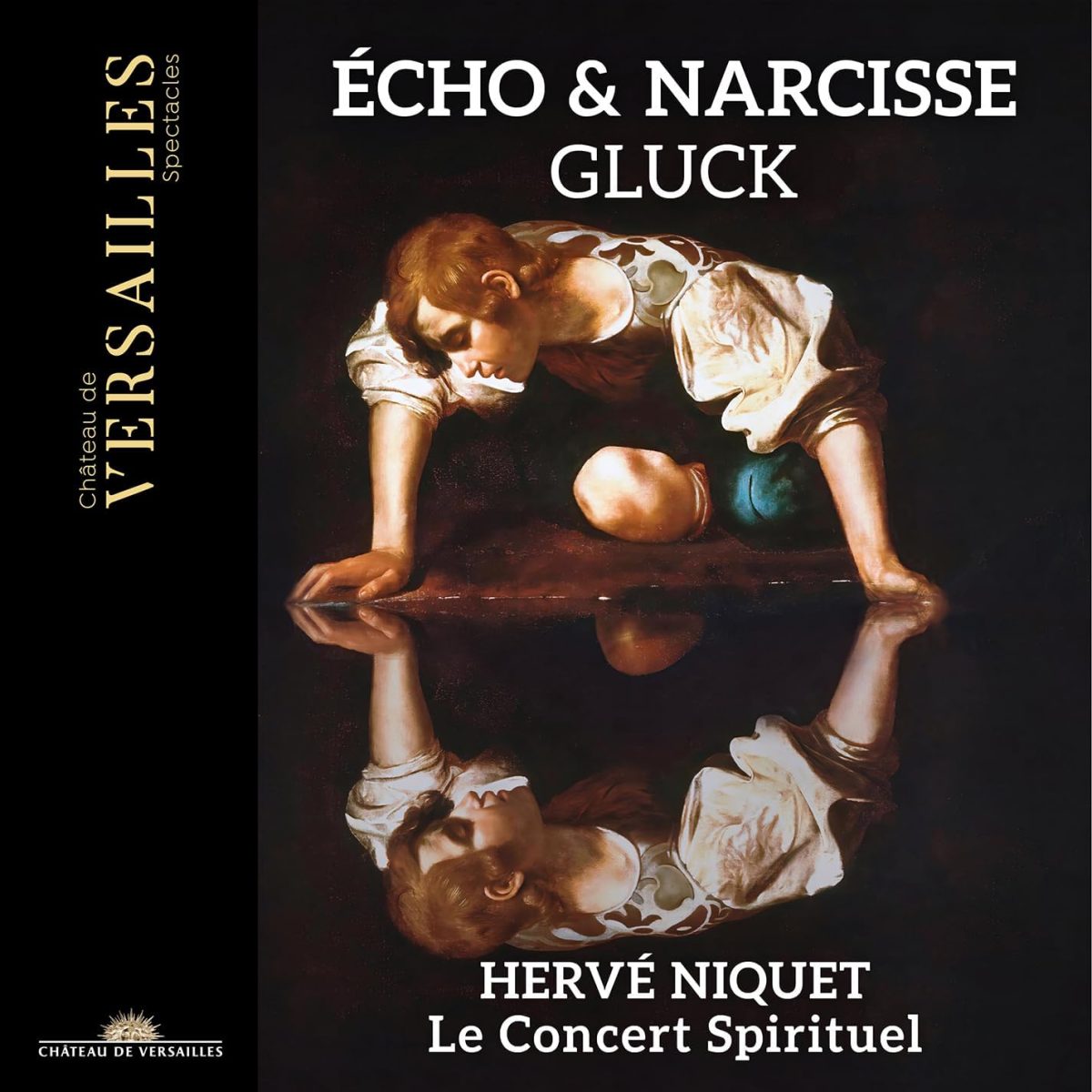
Gluck: Echo & Narcisse

Le Concert Spirituel, Hervé Niquet
102:19 (2 CDs in a card triptych)
Château de Versailles Spectacles CVS095

The excellent Versailles Spectacle concert and recording series brings us this intriguing recording of Gluck’s last opera, Echo and Narcissus, a light pastoral which turns out to be of much more significance than first appearances would suggest. As a result of a mixture of bad luck, bad timing and bad casting the work was a comprehensive failure at its first performances, much to the chagrin of its composer, who clearly felt it deserved a better reception. On the basis of this delightfully understated performance, I can see why Gluck was so frustrated by its lack of popular success. Not always known for understatement, on this occasion Niquet has astutely cast the piece with appropriately light voices and allowed the music to speak for itself. One particular virtue of the work is Gluck’s imaginative orchestral writing, making particularly imaginative use of horns and clarinets. He also largely succeeds in his aim to blend the French and Italian operatic styles – the ‘extras’ are given music with a light Italianate charm while the central characters’ more profound music recalls the music of Rameau – while you would have thought the generally undemanding musical idiom and the episodic nature of the piece would have appealed to the short musical attention span of the French court in 1779. None of these virtues nor even the patronage of Marie Antoinette herself would save the work from failure and obscurity until it was ‘rediscovered’ in the 20th century. The precise and tasteful playing and singing of Le Concert Spiritual bring this little gem to vivid life, and while the positioning, with the chorus and soloists onstage and the orchestra down on the flat tends to flatten out the orchestral colours a little, the overall sound and balance are pleasing, and the acoustic of the Opéra Royal de Versailles provides just the right amount of resonance, reflecting the sound Gluck would have been writing for. It was probably much too late for the self-obsessed and hopelessly superficial court of Louis XVI and Marie Antoinette to learn any valuable lessons from Gluck’s pastoral – in any case, Gluck never returned to opera in the last decade of his life, while just a couple of years after his death the entire edifice of the French Court was swept away in revolution. In many ways, the innocent simplicity of Gluck’s Echo & Narcisse evokes a whole era of French music, part of a culture blissfully unaware of its shortcomings and the gruesome fate that awaited it.

D. James Ross

Categories
Recording

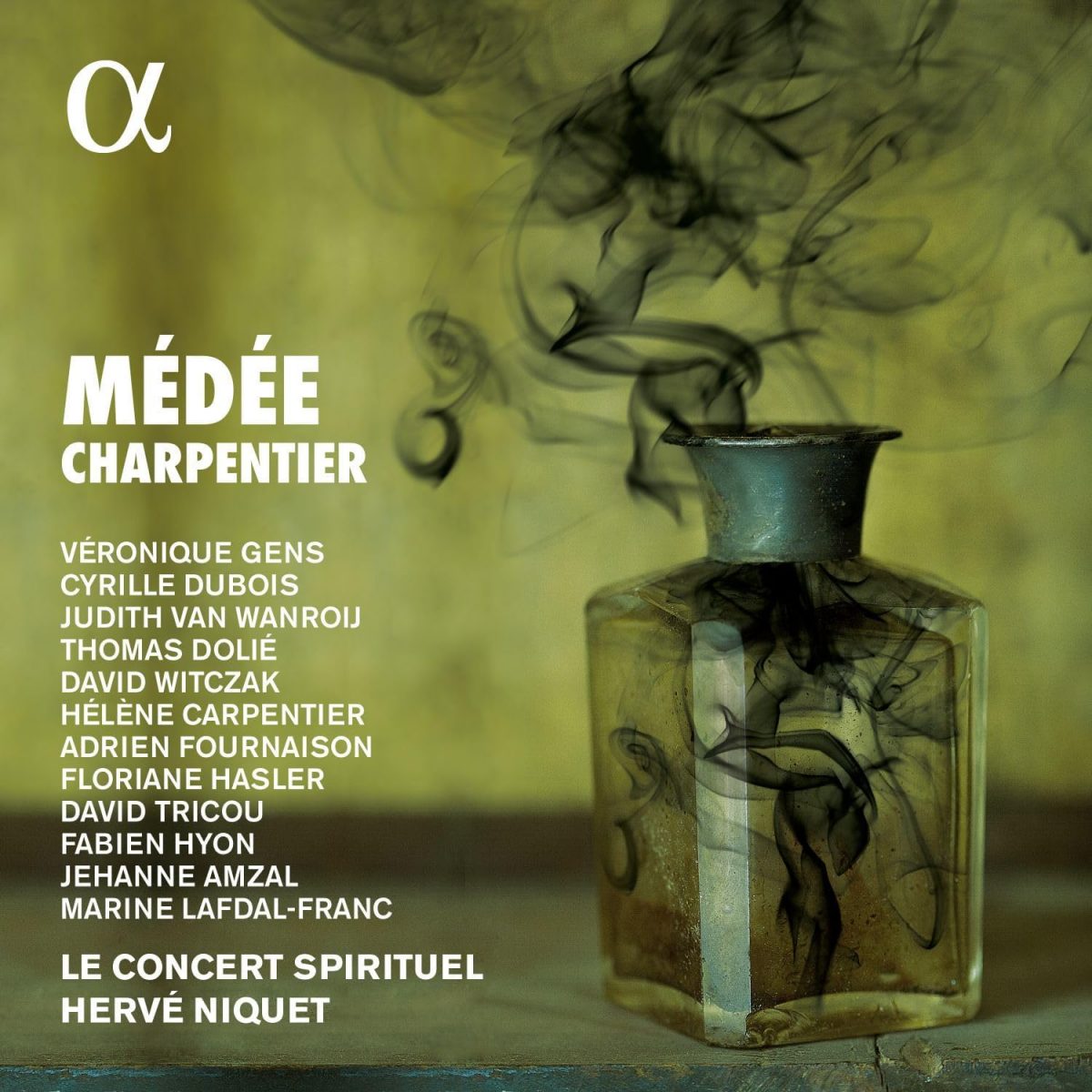
Charpentier: Médée

Véronique Gens (Médée), Cyrille Dubois(Jason), David Witczak (Oronte), Le Concert Spirituel conducted by Hervé Niquet
170:43 (3 CDs)
Alpha 1020

It is nearly 50 years since William Christie’s first recording of Marc-Antoine Charpentier’s Médée (harmonia mundi) vividly illustrated that French Baroque opera meant more than Rameau and the occasional nod in Lully’s direction. Since then Médée has become firmly established and acknowledged not only as Charpentier’s operatic masterpiece – though I would argue that David et Jonathas (1688) should be considered its equal – but one of the peaks of the repertoire.  First performed at the Paris Opéra (Académie Royale de Musique) in 1693 it was one of the first operas given there after Lully’s monopoly was ended by his death six years earlier. Despite the presence of Louis XIV at the premiere, the opera was not a success, receiving ten performances before being withdrawn and not revived until the 20th century.

Cast in five acts with the usual prologue, Médée is a tragédie en musique that for once lives up its genre, a feature that may have some bearing in its contemporary unpopularity. By the end of the opera not only are Créon, King of Corinth and his daughter Créusa, the new amour of Jason dead, but in her fury at Jason’s treachery the sorceress Médée (Medea) has committed filicide. Yet it is measure of the quality of Thomas Corneille’s libretto that far from being simply an irredeemable villain poisoned by jealousy, Médée emerges as a deeply ambivalent character driven to madness by the ingratitude of Jason. The picture becomes more opaque still if her earlier services (the Golden Fleece) to Jason are taken into account. And it is more than just the text, for Charpentier gives to Médée not only music that is highly dramatic but in her act three air ‘Quel prix mon amour’ the most touchingly beautiful music in the score. Musing on whether she should murder her sons, the product of her love for Jason, also give momentary relief from the derangement from which Médée  now suffers, her servant Nérine a little earlier having spoken of her ‘Eyes staring wildly, her steps unsteady’. The role is one tailor-made for Véronique Gens, one of the great tragediennes of our day and a singer to compare with the creator of the role, Marthe Le Rochois, the creator of all the leading female roles in Lully’s tragedies lyriques and who was considered without parallel for her mastery of the declamatory styleGens’s mastery of the role ranges from the imperious in the infernale scene at which she is at her most powerful, displaying some awesome chest notes, to the sheer, pure beauty of her singing in the air noted above.

Her errant husband is given a poor hand by comparison, at his best in the tenderness he displays toward his new love Créuse, its cynical political implications drowned out in the exquisitely sensitive music Charpentier gives the couple in their scenes together (act 1, sc 5 and act 4, sc 2). The experienced Judith Van Wanroij (the cast listing spelling is used in the heading but here the more usual spelling is adopted) is at her best in this kind of gentle heroine role and here she is utterly engaging. There are, too, few finer stylists in haute-contre heroic roles than Cyrille Dubois, though here the fast vibrato that is a part of his voice does occasionally threaten to be a distraction. The only other significant role is that of Creon, which asks for little more than Thomas Dolie’s richly authoritative baritone until the great scene in which he is made mad by Médée (act 4, sc 8/9). Then considerable vocal acting powers are called upon, a demand met admirably by Dolié. 

Among smaller roles baritone David Witczak’s Oronte, the deposed suitor of Créuse, should be noted, as should the enchantingly fresh soprano of Jehanne Amzal in several comprimario roles. Her singing of the Italian air included in the act 2 divertissement is one of the delights of the set. Hervé Niquet’s direction of the prologue, the customary panegyric dedicated to Louis XIV with Glory, Victory and Bellone (goddess of war) doing the honours, is curiously – if arguably understandably – briskly uninvolved. Thereafter it improves significantly without ever becoming one of his finest achievements. Notwithstanding the set is required listening for all Gens’s many fans, who will also encounter a great opera and much excellent singing.

Brian Robins