Categories
Recording

The Musical Treasures of Leufsta Bruk III

Elin Rombo soprano, Rebaroque
61:18
BIS-2354 SACD

Click HERE to buy this on amazon.co.uk

This third CD of music from the collection of Leufsta Bruk manor house in Sweden concentrates on music for soprano and instruments, and for solo organ. The latter, a sonata by F. I. de Boeck, is played by Peter Lönnerberg on the Cahmanorgeln in Leufsta Bruk church – this magnificent Baroque instrument on 1728 is illustrated on the back of the programme booklet. The CD opens with several psalms from the Svenska Psalmboken sung by Elin Rombo, either unaccompanied, with the accompaniment of the organ or a string ensemble. As the original source is for voice and BC, I am little suspicious of the rather over-Romantic suspension-laden string accompaniment. The performances are also a little mystical to be entirely convincing accounts of psalms in this period. Of the four named composers, two, Hinrich Philip Johnsen and Conrad Friedrich Hurlebusch, have close Swedish connections; de Boeck is probably the Antwerp organist of this name and Pierre- Alexandre Monsigny was a French composer of operas. The collection was assembled by Charles De Geer throughout the middle part of the 18th century and was catalogued in 1763 by his son and namesake. The soprano soloist manages a beautifully focused sound for her accounts of the psalms, but when it comes to the Hurlebusch cantata she clearly feels that more vibrato is appropriate – I’m not sure I agree. This unfortunately persists in the most substantial work on the CD, Johnsen’s Kyrko-Musique på Påsk-Dagen, a charming setting for soprano, strings and organ of various liturgical and instrumental interludes for Eastertide. This is delightfully characterful music. The three arias by Monsigny and anonymous which complete the CD are also engaging pieces. The two anonymous arias have both been arranged from melody and BC to accommodate the present forces – I have no objection to this, as the music in family albums such as De Geer’s would have been consistently adapted to suit the musicians available to play on any particular evening. I do question the Pärt-like minimalist drones which characterise the arrangement of the final hymn and indeed the opening psalm – as the programme note puts it ‘past and present meet’, but maybe only in the imagination of the arranger…

D. James Ross

Categories
Recording

Chédeville after Vivaldi: Les Saisons amusants

Ensemble Danguy, Tobie Miller
51:15
Ricercar RIC398

Click HERE to buy this on amazon.co.uk

I have to say when I saw the cover of this CD my heart sank – Les Saisons Amusantes: Nicolas Chédeville (after Antonio Vivaldi). Over the years I have reviewed so many CDs where people felt impelled to ‘muck about’ with Vivaldi’s Four Seasons with more or less disastrous results. However, a closer examination revealed that tampering with Vivaldi was not just a phenomenon of our times – this CD presents a version by Nicolas Chédeville printed in 1739 and arranged in the French taste of the period for ‘les musettes et les vielles avec accompagnement de violon, fluste et Basse continue’! Closer inspection reveals that Mons. Chédeville manages to amass six ‘seasons’, only the first of which (‘Spring’) is a direct transcription of Vivaldi. The other pieces draw freely from other concertos in the Cimento dell’armonia e dell’inventione – Summer’ and ‘Winter’ use none of the music from the equivalent pieces by Vivaldi, while ‘Autumn’ combines the outer movements of the original with the slow movement from Vivaldi’s ‘Winter’. The two additional pieces (La Moisson and Les Plaisirs de la Saint-Martin) are complete confections from the rest of the Cimento. This would appear already to merit the term ‘mucking about’, albeit 18th-century ‘mucking about’. The ensemble has also been selective in their instrumentation accompanying the solo hurdy-gurdy with two violins, cello, bassoon, theorbo/guitar and harpsichord – so no musettes and no recorder as requested by Chédeville. I think the addition of a musette or two might have been intriguing. If you accept the arrangements at face value along with the instrumentation decisions, the performances have a certain charm, and certainly provide a window on the rather bizarre musical world of early 18th-century France, with its wannabe rustic aristocrats milking imaginary cows and expressing themselves on hurdy-gurdies. So this is certainly not just your standard CD devoted to ‘mucking about’ with Vivaldi, but – notwithstanding the virtuosity – I found the unvarying textures, which might have been helped with the participation of recorder and musettes, a little ennui-making. Quelle domage!

D. James Ross

Categories
Recording

Handel: Ode for St. Cecilia’s Day

[Cassandra Lemoine soprano, Benjamin Butterfield tenor,] The Bach Choir of Bethlehem, The Bach Festival Orchestra, Greg Funfgeld
Analekta AN 2 9541

Click HERE to buy this on amazon.co.uk

This recording celebrates the 120th anniversary of America’s oldest Bach choir, The Bach Choir of Bethlehem based in Pennsylvania, which holds the honour of having given the first US performances of Bach’s B minor Mass and Christmas Oratorio. It is a large choir and the Bach Festival Orchestra play on modern instruments, and while Greg Funfgeld clearly encourages a vibrato-free sound from his tutti strings, some of the solo string episodes sound a little over-romanticised, while the large vocal ensemble can sound a little overwhelming and spongy. The two vocal soloists have pleasant focussed voices and give passionate accounts of their arias. This recording is never less than pleasant and enjoyable, but to my ears it sounds a little dated in conception. I couldn’t avoid comparing it to a performance I discovered recently on you-tube by the Florida-based ensemble Seraphic Fire of Handel’s Zadok the Priest – state-of-the-art period instrument playing and some of the best choral Handel singing I have ever heard. It really depends what you want from your Handel – I find now that I derive little pleasure from performances with large numbers of voices and modern instruments, such as the rather pinched piccolo trumpet we have here. I know that within a few years of Handel’s death performances of his music with massed choirs were all the vogue, but for me once I had heard the clarity and precision of small period-instrument bands and specialist choral forces, I was dissatisfied with the alternative. If this doesn’t bother you, you will find this account by the American forces perfectly enjoyable, and indeed it is a reading into which a lot of thought has gone, and it is never less than musically tasteful and honest.

D. James Ross


Categories
Recording

Corelli: Solos and Concertos Fitted for the Flutes

Estro Cromatico, Marco Scorticati
57:38
Arcana A112

Click HERE to buy this on amazon.co.uk

Corelli at his most inventive and lyrical, beautiful recorder playing sympathetically supported by a classy continuo team – I need hardly say any more! Well, I should probably address the issue that Corelli probably wrote no original music for recorders, and that these Sonatas and Concerti ‘fitted for the flutes’ were arrangements published in London in 1702, 1707 (the Sonatas) and 1725 (the Concerti) to satisfy the enormous demand for music for the newly fashionable recorder. The Sonatas are arranged from Corelli’s op 5 Violin Sonatas, and while they sound technically very demanding, they are played here with enormous assurance. The Concerti, on the other hand, are arrangements of Corelli’s famous op 6 Concerti Grossi, – ironically in their first edition of 1720 inexplicably missing out one or two of the more famous movements, such as the famous Christmas music! These were restored in the 1725 edition performed here, allowing the CD to end with this charming seasonal music which sounds like it was written with recorders in mind! Indeed all of these concerto arrangements sound utterly convincing on two recorders and continuo, and Estro Cromatico perform them with considerable flair, tastefully decorating as appropriate. It is easy to hear the influence of these transcriptions on the resident London composers such as Paisible, Loeillet and Sammartini, all of whom produced substantial amounts of music for recorders and some of whom may even have been involved in the Corelli arrangements. The indefatigable John Walsh, Handel’s chief publisher, was the driving force behind the publication of these arrangements, which proved very popular at the time, and provide recorder players nowadays with legitimate access to the music of Corelli.

D. James Ross

Categories
Recording

de Grigny: [Premier] Livre d’orgue | Lebègue: Motets

Nicolas Bucher, Ensemble Gilles Binchois, [Marion Tassou dessus, Vincent Lièvre-Picard taille]
159:13 (2 CDs in a card triptych)
Edition Hortus 184

Click HERE to buy this on the publisher’s website

You have to work quite hard to divine what music these discs offer so here’s a summary. Disc 1 is Nicolas de Grigny’s organ mass from his sole Livre d’orgue, with appropriate plainchant insertions (three cheers for this!). On Disc 2 there are his alternatim hymns, again complete with the necessary chant, and settings of those same texts by Lebègue. The booklet (French and English) contains neither the texts/translations nor any real commentary on the music (not a word on the Lebègue) and the English translation is often more a string of words than meaningful sentences. Also missing are full details of the organ, and I couldn’t find them on the website to which reference is made either, though it’s sonically quite splendid – four manuals and all the colours. However, like all the modern players I have heard, Nicolas Bucher eschews the tremblant fort when it comes to the grands jeux though I can’t believe that there isn’t one.

Bucher does, however, play with great love of and understanding of the style (he is the general director of CBMV) – noble is the word that springs most readily to mind to characterise his approach. This would also be an appropriate epithet for the singing of the well-researched chant – though sometimes it does verge on the ponderous, as if a concern for perfect ensemble were over-riding a true feel for the lines.

I’m afraid that the performances of the Lebègue motets contributed little to my enjoyment of the programme.

So, poor supporting materials, some thrilling organ sounds and music good enough to have attracted the interest of JSB, no less. But that’s another story.

David Hansell

Categories
Recording

Cavalli: Missa 1660

Galilei Consort, Benjamin Chénier
69:05
Château de Versailles Spectacles CVS006

Click HERE to buy this on amazon.co.uk

Part of the growing series of DVDs and CDs recorded in Versailles Palace and featuring the very finest of European early music performers, this programme, recorded in the Palace Chapel Royal is a reconstruction of the Mass celebrated in Venice in 1660 to mark the signing of the Treaty of Paris which prepared the way for the marriage between Louis XIV and the Infanta of Spain. This reconstruction presents Cavalli’s magnificent concertante setting of the mass ordinary from Musiche Sacre with liturgical interpolations from a couple of his other publications. The performers go all out for the lavish, with elaborate fireworks from a pair of cornets and decoration of the string parts, while the Chapel Royal acoustic emphasises the dramatic juxtaposition of contrasting textures between the flamboyantly showy and the contemplatively intimate. Just occasionally the upper vocal soloists employ more vibrato and less precision than I am comfortable with, but there is always a fine sense of drama. When Peter Holman recorded the Mass in 1997 with Seicento and The Parley of Instruments (Hyperion CDA 66970) he was apparently unaware of the documentation linking it to the 1660 celebrations, and their performance is less flamboyant, using just eight solo voices and more modest instrumentation, but it is markedly more focussed and detailed than the present French account. While I enjoyed the unashamed theatricality of the latter, I found myself occasionally yearning for the beautifully nuanced solo singing of Seicento.

D. James Ross

Categories
Recording

The Dubhlinn Gardens

Anna Besson, Reinoud van Mechelen, A nocte temporis
69:17
Alpha Classics Alpha 447

Click HERE to buy this on amazon.co.uk

This CD is the pet project of the group’s flautist Anna Besson, whose idiomatic traditional approach to the Baroque flute gives these performances a wonderful authenticity. The music belongs to the vogue for music from the ‘celtic fringes’ of the British Isles, which followed the storming success of The Beggar’s Opera with its use of traditional Scotch and Irish melodies. While many of the instrumental tracks have a suitable twinkle in their eye, the songs are less effective. Belgian tenor Reinoud van Mechelen does his very best, but doesn’t seem to ‘get’ the idiom and struggles with the Irish accent the texts seem to cry out for. Perhaps we would have done better with a singing actor type (as featured in the original performances of The Beggar’s Opera) than van Mechelen’s rather cultivated tone and delivery. This is a pity as much of the selected repertoire is unfamiliar and delightfully lyrical, and the overall idea of the project is an exciting one – the vocal tracks however do tend to labour a little or just to sound a bit worthy. In the slower airs, van Mechelen seems more at home, and his account of “Ah! The poor shepherd’s mournful fate” is lovely, although again the ornaments in the unaccompanied “Eileanóir a rún” sound more like Monteverdi than the subtle inflections of the folk singer.

D. James Ross

Categories
Recording

innamorato | triloia italiana

accordone, macro beasley, guido morini
188:54 (3 CDs in a card folder)
cypres CYP9620

Click HERE to buy this on amazon.co.uk

For this collection of Italian music from the 16th, 17th and 18th centuries, Accordone have selected three recordings from their back-catalogue dating from 2005, 2006 and 2007. It has to be said that the rigour of the background scholarship and the spontaneity of the performances mean that these have not dated at all. The initial disc focuses on Frottole, and is a delightfully engaging journey through the 16th century, bringing familiar composers such as Lassus and Tromboncino together with a host of less familiar names, such as Marco Cara, Pietro Paolo Borrono and Guglielmo il Giuggiola. This unearthing of unknown music by unknown composers is one of the main strengths of all three CDs, as indeed is the distinctive voice of Marco Beasley. His pleasing tenor is a major factor in the appeal of all three CDs – it is an individual sound, with a similar texture to the voice of Nigel Rogers and equally adept at sparkling ornamentation. In the Frottole volume, the ensemble manages a wonderfully spontaneous sound, verging on the performance style more often associated with traditional music. This proves ideal for the no-nonsense directness and beguiling charm of these Frottole. In the second CD Recitar Cantando we encounter repertoire for solo voice and continuo with obbligato instruments again by familiar names such as Monteverdi, Frescobaldi and Caccini and unfamiliar contemporaries such as Cherubino Busatti along with instrumental music by Giovan Battista Fontana. The slightly elusive programme note for this CD doesn’t detract from the delight of the performances, although a more detailed account of how and why the performers felt free to adapt the messenger scene from Monteverdi’s Orfeo and his dramatic madrigal Il Combattimento di Tancredi e Clorinda for solo voice and small consort would have been helpful and interesting. Just occasionally, as in Il Combattimento (which is by far the most substantial piece on the CD), Beasley, who has to sing all three characters himself, doesn’t quite imbue the vocal lines with the drama they seem to demand – there is a reference in the programme note to letting the character sing rather than the performer. This seems to be a little lacking here. For the third CD Il Settecento Napoletano we visit the musical hot-spot of 18th-century Naples. In a city where we now know opera was a major focus of attention, it is no surprise that solo secular cantatas were also very popular. It seems to my ear that these performances of ‘cantatas in the Neapolitan language’ are sung in a distinctive Neapolitan dialect, and again while Alessandro Scarlatti and Nicola Matteis (who supplies a trio sonata) are relatively familiar, Giuseppe Porcile, Giulio Cesare Rubino, Alonso dei Liguori and Guido Morini are new to me. As in all three CDs, it is interesting how the music by the ‘unknowns’ is invariably every bit as effective as that by the big names. These attractive pieces are greatly enhanced by the imaginative scoring of the accompaniments, while vocalist Marco Beasley seems more in tune with this later idiom. This is an enjoyable collection of CDs currently otherwise unavailable and definitely to be recommended for their underlying intellectual rigour and the musicality of their performances.

D. James Ross

Categories
Recording

The Violin’s Delight: A Garden of Pleasure

Plamena Nikitossova violin,  Julian Behr theorbo,  Matthias Müller violone,  Jörg-Andreas Botticher harpsichord/organ
70:02
Claves 50-1727

Click HERE to buy this on amazon.co.uk

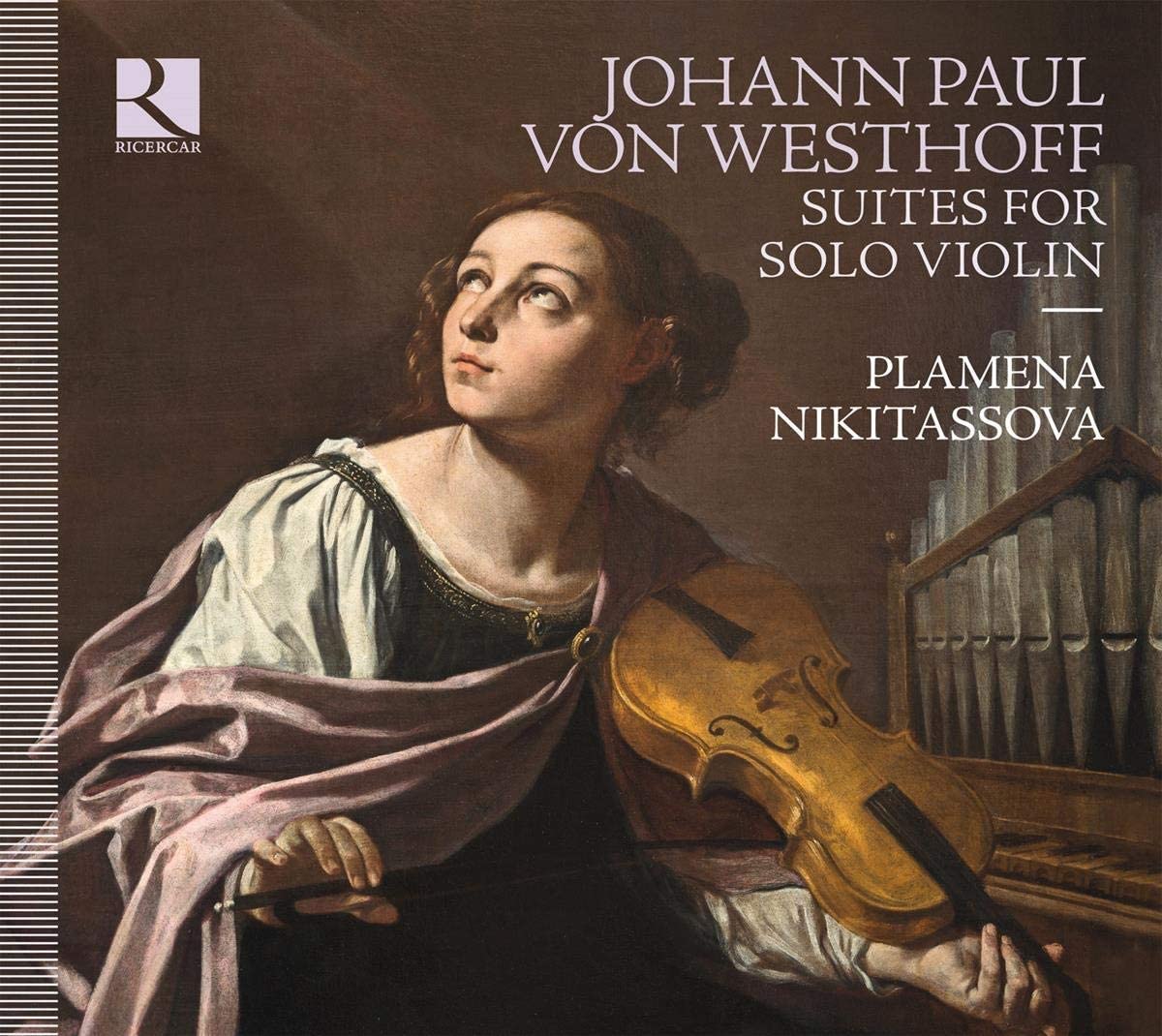
This exploration of the fantastical world of 17th-century virtuosic solo violin music adds a number of names to the increasingly familiar Heinrich Ignaz Franz Biber and Georg Muffat. Heinrich Lizkau, Phillip Friedrich Böddecker, Heinrich Döbel, Johann Jacob Walter and Johann Caspar Kerll can all hold their heads up in this impressive company, producing wildly imaginative music for solo violin, which jumping a generation or two seems to have more in common with the technical fireworks and sheer fantasy of the likes of Paganini. As a Biber fan of long standing, it is exciting to have confirmed that he was by no means working in isolation, and we can almost hear these composers vying with one another in the sheer quirky creativity of their compositions. Plamena Nikitossova plays with stunning virtuosity and enormous flair,  as well as a saucy wit where appropriate, and the distinctive playing position she adopts following the advice of Georg Falck’s 1688 treatise Idea boni cantoris adds a certain authenticity to her approach. Her Jakobus Stainer violin of 1659 has a rich and flamboyant tone, while her continuo team employing a modern copy of a Stradivarius guitar (!), theorbo, violone, a clavimusicum omnitonum, and the 1642 organ of the Franziskanerkirche in Vienna are sympathetically supportive.

D. James Ross

Categories
Recording

Pietro Migali da Lecce : Sonate a trè

Ensemble BariAntiquA
64:17
MV Cremona MVC 017/44

Click HERE to buy this on amazon.co.uk

Migali’s Sonatas for ‘doi violine, e violone, ò arcileuto, col basso per l’organo’ printed in Rome in 1694 are preserved in the archives of his home town Lecce in southern Italy. A professional musician, Migali’s op 1 sonatas – his only surviving printed work – appeared when he was around 60 (he lived into his 80s) so probably reflect the work of the mature composer, and indeed sound very confident in their style. This has been brought under the broad umbrella of the ‘Roman school’, later exemplified by Corelli, and indeed Migali may have been briefly resident in Rome around the time of the publication. These works have the same easy melodic flow and constant lyricism of Corelli and in these beautifully idiomatic performances their full charm is revealed. The ensemble go for the arcileuto option rather than the violone, alternating and augmenting it with a theorbo along with the stipulated organ. The light accompaniment is beautifully responsive and subtle, allowing the two solo violin parts, tastefully and expertly played by Dario Palmisano and Michele Saracino, to soar freely as intended by the composer. Intriguingly, in addition to stipulating so precisely his ideal instrumentation, Migali also seems to have added bowing marks to his scores – an unusual early example of this sort of intervention, but unfortunately not entirely clear in meaning.

D. James Ross