You can download this article as a PDF by clicking Ambronay40.
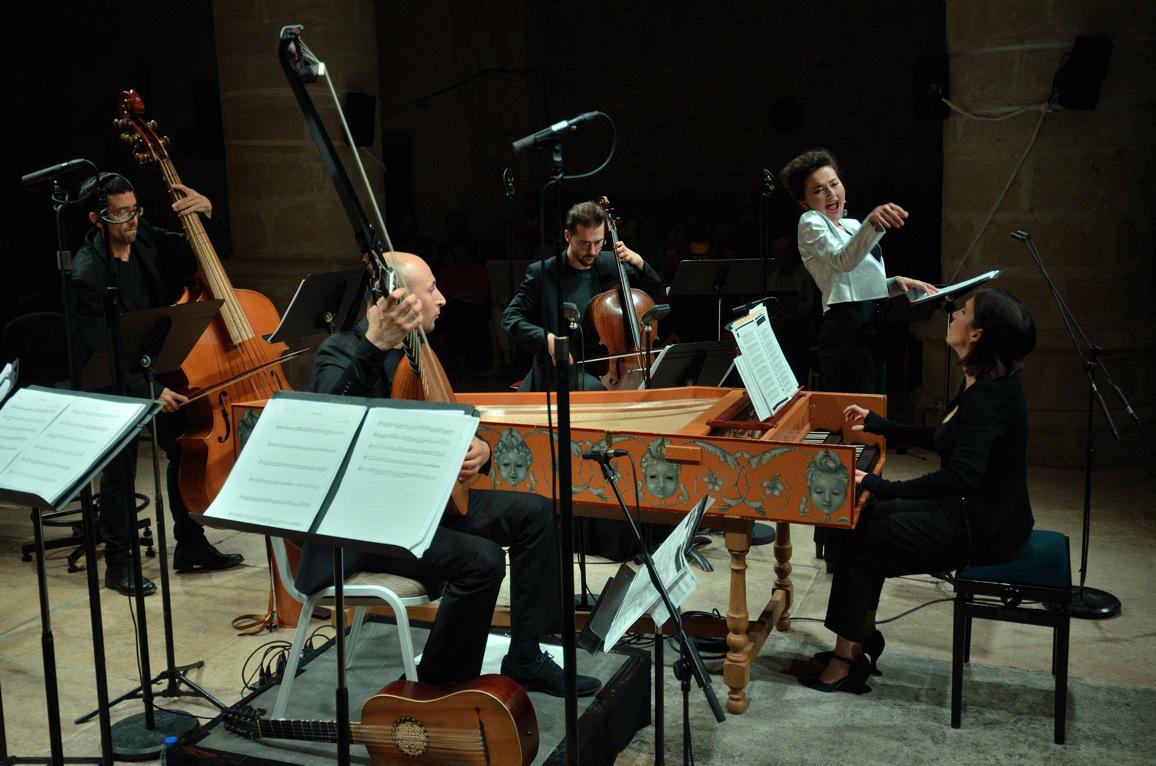
Photo credit: Stéphanie D’Oustrac with Amarillis – Ambronay Festival 2019 © Bertrand Pichène
Over the years I have sent many reports of the Ambronay Festival to EMR and elsewhere, so the occasion of the 40th Anniversary season has prompted me to think along rather different lines. What follows therefore is a personal retrospective covering attendance at a quarter of the total of Ambronay’s festivals. My excuse, reason – call it what you will – for doing so is the unique and treasured relationship, no less than a love affair, that has developed over that time between us (my partner Anne and myself – to whom all future references of ‘us’ or ‘we’ refer) and the festival. As with all love affairs, that has not meant blind acceptance of everything that has been seen and heard, as we will see.
First, though, let’s just remind readers who may not know that Ambronay is a small village some 35 miles northeast of Lyon, lying close to the foot of the thickly wooded hills of the Haut Bugey, pre-Alps forming a southern continuation of the mountains of the Jura. It’s a pleasant if unremarkable kind of place, the kind you might easily drive through without noticing the medieval Benedictine abbey church set back from the main street. Yet Ambronay and its abbey church, which is blessed with outstanding acoustics, are home not only to one of Europe’s most prestigious early music festivals, but also to an ambitious cultural centre of worldwide importance, founded in 2003. The festival itself was founded in 1980 by Alain Brunet, whose presence still graces the festival and about whom more later. Among artists to appear at early editions of the festival were the late Jean-Claude Malgoire and William Christie, who made his debut in 1984.
Our own first appearance at Ambronay came in 2009, the 30th Anniversary Season, which like the current celebratory season featured many of the artists particularly associated with the festival. As it happened, our first event did not take place at Ambronay itself, but in the theatre of the nearby town of Bourg en Bresse, a performance of Monteverdi’s L’incoronazione di Poppea directed by Leonardo Garcia Alarcón. That was also the night we met for the first time the festival’s international press agent, Véronique Furlan, a slight young woman who by coincidence was also experiencing her first festival. It must be confessed that on that occasion Véronique made little impression on me, but since that night she has become a much valued and indeed admired friend who, along with her husband Daniel and daughter Lila (yet to be born at the time), became a major component of the annual ‘Ambronay experience’. Véronique is one of those exceptional people with the extremely rare gift of making all those who come into her orbit feel they are of importance to her; beyond that she is quite simply the most efficient press agent I have ever encountered.
But back to that Poppea. Although the performance was a highly commendable example of the commitment Ambronay has always had to developing young artists, being given as it was by recent alumni and present members of the early music departments of the conservatoires of Lausanne and Geneva, it would also be the first of several occasions that occasioned reservations about the work of Alarcón. Here it was the conductor’s greatly inflated instrumental forces that jarred, more a large Renaissance band after the manner of Orfeo. A couple of years later Alarcón, who by then had become Ambronay’s chief artist-in-residence, presented a ‘colourful’ (to put it mildly) version of Il diluvio universale, a re-discovered oratorio by the little-known Sicilian composer Michelangelo Falvetti, an aberration made worse by the fact that that it was supposedly following a scholarly version published by Ambronay’s admirable academic research department. It does not enhance Ambronay’s credentials as an early music research centre that Alarcón’s corrupt Il diluvio, with its ‘world music’ interpolations – Ambronay has a strong folk ‘fringe tradition’ – was revived for the 40th Anniversary season.
In the early years of visits to Ambronay we were living in France, little more than an hour’s drive on the autoroute. It meant that we were able to attend concerts throughout the festival’s four weekends, traditionally held from the second weekend in September to the first in October and that first year we feasted on a range that covered a gamut from Handel’s oratorio Susanna directed by William Christie to the rarely heard intermedi for La pellegrina that formed part of the 1589 Medici wedding celebrations, performed by suitably lavish forces under the direction of Skip Sempé. Notwithstanding such large-scale pleasures, the most memorable concert of that year was a more intimate affair, a programme devoted to chamber settings of Vespers for the Virgin given by Concerto Soave, a concert dominated by Maria Cristina Kiehr, a singer whom I noted exuded ‘an aura of calm repose when not singing and a mesmerising hold on an audience when she is’. Two years later, Kiehr and Concerto Soave would prove equally entrancing in a cycle of works by such as Mazzocchi and Monteverdi devoted to episodes in the life of Christ.
In those days, the solo and small-scale concerts took place in the medieval Tour Dauphine, situated in the abbey grounds, later restored and today the mess where artists, Ambronay staff and invited visitors take their meals. This interaction is, I’m sure, one of the reasons for the agreeable ambiance of the festival. It was in the Tour we first heard (in a recital of Haydn songs) Stéphanie d’Oustrac, a young mezzo and alumnus of Ambronay’s Baroque Academy who was already starting to make waves at the start of what has since become an international career. Happily d’Oustrac was able to take part in Ambronay 40, giving the only concert we heard this year, a recital entitled ‘Éclats de folie’ (outbursts of madness) with the ensemble Amarillis, a subject eminently suited to a singer that has always shown a gift for strong dramatic projection. Here d’Oustrac was probably most successful in Purcell’s ‘Bess of Bedlam’ and ‘From Rosy bowers’ (Don Quixotte), her performances of Handel’s cantata ‘Ah, crudel’ (HWV 78) , and French repertoire by Campra, Marais and Destouches (extracts from Sémélé ) a little marred by what has become a fairly wide vibrato doubtless developed as a result of the singer having moved on to later, heavier repertoire. On their own, the accomplished Amarillis gave performances of works by Heinichen, Rebel, Eccles and Keiser.
In 2011 our visits to Ambronay underwent a fundamental change that would enhance our future relationship with the festival and those that administer it. This year the warmth and hospitality extended even to critics (!) was further enhanced by the offer of weekend accommodation in the newly and beautifully restored late 17th-century wing of the abbey complex, formerly the monks’ cells. We took advantage of this offer on the opening weekend, apparently the first people to stay in the spacious room we occupied since its restoration. It was tempting to imagine we might just have been its first occupants since the monk whose home it was in pre-Revolutionary days. Staying on the premises meant that since that time we have developed ever greater ties with the wonderful permanent and voluntary staff that make Ambronay what it is. Over the years these have become lasting friendships with many people, extending from founder and long-time general director Alain Brunet, the vivacious Mme Brunet and their charming daughter Marie to the be-whiskered doorman who now never fails to greet me without an enormous hug.
Our first concert that year also provided an introduction to an ensemble with whom another lasting friendship has developed. For critics, friendships with artists are always difficult territory, but such is the strong group personality and infectious delight in music making always displayed by Les Esprits Animaux, then one of Ambronay’s young ensembles in residence, that such reservations rather tended to be swept aside. Subsequent encounters with their seven members have always been hugely enjoyable, a concert they gave in 2017 in the church of the famous medieval fortress village of Pérouges, some 40 kms from Ambronay, remaining vividly in the mind. About that concert I wrote that ‘the players have matured into a truly outstanding chamber ensemble that now plays with real finesse and finish without having lost any of the vitality and evident pleasure they derive from making music together.’ Sadly we missed Les Esprit’s appearance at Ambronay 40. Incidentally, mention of Pérouges reminds me that it should be stressed that the festival has always been happy to ‘outsource’ its events over the region, having a strong relationship with Ain, the département in which it is located.
Both as an institution and in regard to the fabric of the wonderful location it occupies, the Ambronay Festival has never stood still. In 2012 the Tour Dauphine was replaced by the Salle Monteverdi, a renovated space lying within the main abbey complex and serving as a rehearsal hall in addition to becoming the main venue for smaller-scale concerts. It therefore became the location for the final assessments of a newly-established EU initiative with the less than beguiling name of eeemerging. Designed to give young early music ensembles residencies at early music festivals and concert series throughout Europe, initially four, later six, groups compete annually in front of the directors of festivals with which Ambronay interacts (including York), while audiences are invited to make their own choice. Over the years we have attended, the overall standard has been exceptionally high, making it an encouraging experience that renews faith in the future of early music. It has to be confessed, though, that I have rarely been in agreement with the verdict of the distinguished jury.
It would be probably somewhat tedious for readers to provide a listing of all the notable concerts we’ve attended at the Ambronay Festival over the years, but even as I write memories tumble into my head. So I hope I will be forgiven for mentioning a few of the most special ones. Sigiswald Kuijken, for some inexplicable reason the least celebrated of the great pioneers of the early music revival, is one of many who has had a special relationship with Ambronay, particularly its Academy. The late Clifford Bartlett, the founder of EMR, once wrote of how one can sometimes completely out of the blue encounter an amazingly powerful musical experience. Kuijken’s 2011 Mass in B minor was such an occasion. The one-per-part performance was shared between thirteen young singers, giving an opportunity for a large number to participate in one of the most challenging works in the repertoire. As I recorded, ‘The near-unbelievable musical quality and deep commitment of the performance was a tribute to those who had coached these young performers from no fewer than 20 countries, above all Kuijken, who produced an utterly dedicated performance that fused all his wisdom and long experience with fresh, exceptional talent’, producing ‘a performance that ultimately provided me with one of the most moving experiences of a long musical life, an experience that was about so much more than just music.’
Unquestionably the most memorable events of more recent years are the two concerts of Monteverdi madrigals given in 2015 and 2016 by a vocal ensemble drawn from Les Arts Florissants under the direction of Paul Agnew. The first, devoted to a selection taken from Books I to III featured performances with ‘textures and chording marked by superb finesse and finish’, but in which Agnew at times inspired his singers ‘to near operatic dramatic intensity’. ‘Throughout this compelling programme’, I concluded, ‘Agnew, who directed with understated authority as an ensemble member, seemed to be living every moment, each note.’ The following year Agnew gave extracts from Books IV, V and VI, which I described as, ‘searing, vividly dramatic and expressionistic performances. This was, quite simply, music making that scorched itself into the soul.’
And so Ambronay has reached another landmark. Surprisingly little has changed over the decade we have known it. Naturally there have been arrivals and departures, the departure of sécretaire générale Catherine Jabaly, who was so kind to us in the early years was a sad moment, while the ever-amenable Alain Brunet, who had been looking increasingly tired, handed over the reigns of the general directorship to Daniel Bizeray after the 2013 season. Relieved of the burden, Alain has now become president and gained a new lease of life, happily as much in evidence at the festival as he ever was.
Unsurprisingly Ambronay 40 brought in to celebrate an influx of luminaries who had long been associated with the festival, among them William Christie, Jordi Savall, Christophe Rousset and countertenor Philippe Jaroussky, along with more recent additions to the French early music scene such as Sébastian Daucé’s outstanding Correspondances. The prime reason for our attendance – other commitments regrettably making it a brief visit – was Rousset’s fine performance of Handel’s Giulio Cesare, dominated by the magnificent Sesto of Ann Hallenberg, one of the great mezzos de nos jours. But you’ll have to go to Opera magazine to read my full review of that. Should you go to Ambronay if you’re an early music enthusiast who has not yet been? Assuredly. Set aside next September now. Will I be there to celebrate Ambronay 50? Certainly, if destiny allows, for true love only grows even stronger with the years, and, to re-quote my earlier words, Ambronay is about ‘so much more than just music’.
Brian Robins