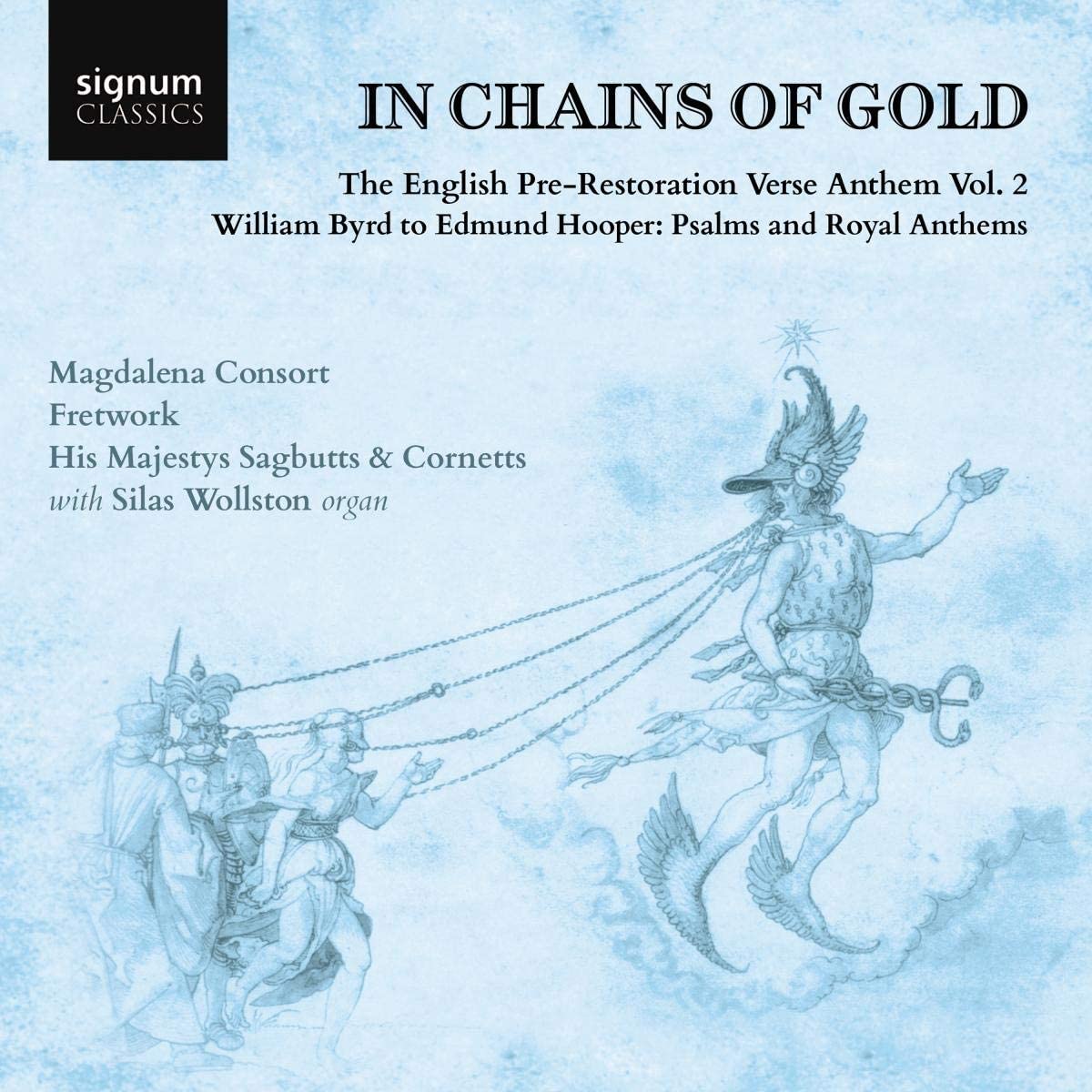
William Byrd to Edmund Hooper: psalms and royal anthems
Magdalena Consort, Fretwork, His Majestys Sagbutts & Cornetts, Silas Wollston organ
70:29
Signum Classics SIGCD609
Byrd: Hear my prayer, O Lord rebuke me not, Have mercy upon me O God Fantasia BK46, Teach me O Lord, Christ rising again, I will give laud, Look and bow down Bull: Almighty God which by the leading of a star, Fantasia MB 16, Deliver me O Go. Cosyn: Voluntaries 1 and 3 Morley: Out of the deep Hooper: Hearken ye nations, O God of gods John Mundy: Sing joyfully
We were lucky enough to receive two copies of this recording for review, and here are the two reactions to it. Firstly (in the order in which they arrived in my inbox!), Richard Turbet then David Stancliffe.
This is the second volume in the series which began with a well-received disc of all the surviving consort anthems by Orlando Gibbons. It features Byrd, plus his pupils Morley and Bull, and their contemporaries Edmund Hooper and John Mundy, with organ solos by Benjamin Cosyn. The music itself is varied and of the highest quality, the performers are among the finest in this repertory, the scholarship behind it is in the distinguished hands of Andrew Johnstone whose doctoral thesis is on Byrd’s Anglican music, and the artistic director is Bill Hunt, founder-member of Fretwork who, at the time of writing, is engaged upon a doctoral thesis about consort anthems.
The proceedings get off to the best possible start with the first of three Byrd premieres: Byrd’s oeuvre runs to well over five hundred works, and his entire repertories of Latin, keyboard and consort music have been recorded. However, there are many gaps in the English-texted music, both sacred – liturgical as well as domestic – and secular. Hear my prayer, O Lord is one of Byrd’s three surviving verse anthems (with an accompaniment for the organ and therefore intended for use in the Anglican liturgy) but Andrew Johnstone feels that he has evidence that it originated as a consort anthem, with an accompaniment for viols indicating domestic performance. Although this is open to interpretation, it is entirely appropriate to be open to alternative possibilities and to air them in a project such as this. In any event, this piece is a gem and its eventual appearance on a commercial recording is greatly to be welcomed. O Lord rebuke me not is the second of Byrd’s surviving liturgical verse anthems on this disc, and again Andrew Johnstone feels that there is evidence of domestic origins. There have been a couple of previous recordings of it with an organ by cathedral choirs (Salisbury and Lichfield), but it is no less welcome here in this experimental – and, who knows, perhaps authentic – guise. The third of Byrd’s trio of surviving liturgical verse anthems Teach me O Lord is performed as such, with organ, but with an intriguing slant to its interpretation. The verse is in triple time, and the chorus in duple. Normally this is performed as dotted semibreve = semibreve when passing from verse to chorus (with the reverse from chorus to verse), as in volume 10a of The Byrd Edition (p. 43 passim) or simply retaining the value of each note, i.e. semibreve = semibreve. In this recording the verse and chorus are rendered with a proportional relationship between the triple and duple sections, resulting in the verse being sung much more briskly than is usually the case. Having recovered from the initial surprise and listened several times, I am still not convinced, but none of us were there at the time, Byrd’s manuscript does not survive, contemporary sources are inconsistent, and insufficient research has been published, so it is again thoroughly worthwhile to use this recording as a vehicle for such an experiment.
The second of Byrd’s premieres is I will give laud, one of several fragmentary songs that survive in a lutebook from the Paston collection from which crucial parts are missing, hence their skeletal appearance in volume 16 of The Byrd Edition. Andrew Johnstone has done heroic work in making this song performable, and there is word of a forthcoming publication containing several other such Byrd reconstructions. The text is the usual excruciating paraphrase of a psalm, in this case the luckless XXXIV, perpetrated by Thomas Sternhold, and the form is ten verses sung by a soloist in the measure of a galliard, accompanied by a quintet of viols, with a chorus repeating the final two lines of alternate verses.
The third of the trio of Byrd premieres is the majestic Look and bow down. Byrd, who was what we would nowadays call the Master of the Queen’s Musick, sets a poem by Queen Elizabeth thanking God for assisting mainly Herself in seeing off the Spanish Armada in 1588. Again, major reconstructive musical surgery was required from Andrew Johnstone. (At least two previous attempts, by experts on respectively Byrd and the Paston sources, had been made, to try to create a performable song out of the intractable fragments.) It was first sung outside St Paul’s Cathedral, so the decision was taken for this recording to use an accompaniment of winds, as would have been the practice at the time. Mean and triplex soloists respectively sing the first two verses, the final lines echoed by the chorus, then the soloists join together in the final verse, to make a glorious conclusion with the four wind instruments, the organ and, for the repetition of the final couplet, all the available singers. The resulting sound is magnificent, with the prevailing dignified minor tonality giving way to a moving evocation of “The soul of me his turtledove” in the final line.
That concludes the Byrd half of the disc, and it is followed by Bull’s famous Starre Anthem and Deliver me, O God, another premiere, which is set to a text said also to be by the Queen celebrating the defeat of the Armada. Towards the end of the record are two powerful anthems by Edmund Hooper, a fine composer who seems to have been neglected simply because of the sheer number of gifted contemporaries. He is no less gifted than most of them, however, and although there is a fine recording of his services and anthems by The Choir of Selwyn College, Cambridge under Andrew Gant (Lammas LAMM 096D), these two works receive their premieres on the present disc. Hearken ye nations is a bracingly grumpy work which loquaciously celebrates the failure of the Gunpowder Plot, while O God of gods was composed for the Accession Day of James I as king of England and, like Byrd’s Look and bow down, ropes in winds, a substantial chorus, and even a session musician on tenor dulcian, to bring the proceedings to an appropriately regal conclusion.
All the other pieces on this disc – the better-known anthems needing less editorial labour and the works for organ – go towards making this a most attractive and enthralling programme, supported by a booklet that is both scholarly and readable. From an engineering point of view, just occasionally the second vocal line down could have been given more presence (such as in the third verse of Look and bow down), otherwise this recording sounds as elevated as the quality of the music it presents. The performances leave nothing to be desired. The viols and wind are, as I have already said, the top of their profession. All the singers are excellent, among whom Elisabeth Paul and Zoe Brookshaw (“mean” and “triplex”) have prominent roles. But every individual performer, alongside their technical and musicological colleagues, has been crucial in making this an outstanding disc.
Richard Turbet
This is the second volume of Bill Hunt’s great project to edit and record the corpus of pre-Restoration Verse Anthems, of which Volume 1, focussing on Gibbons, appeared in 2018 and was reviewed in January of that year.
This second volume has a wonderful range of music starting with William Byrd and moving through John Bull and Thomas Morley, interspersed with short voluntaries for the organ by Benjamin Cosyn, to John Mundy and the great discovery for me – Edmund Hooper, whom I only knew as the composer of a set of evensong canticles. Three of Byrd’s penitential psalms begin the programme, and after Teach me, O Lord, Christ rising again and I will give laud (a splendid five-part reconstruction by Andrew Johnstone of a swinging lyric rather in the manner of Though Amaryllis dance in green), comes Look and bow down, a setting of words by Queen Elizabeth herself which was ‘performed at Sainte Pauls crosse in London’. It is accompanied by cornets and sackbuts on this recording as in all probability it was sung outside the cathedral after the Bishop of Salisbury’s sermon at the conclusion of the service to give thanks for deliverance from the Spanish Armada.
One of the welcome features of this distinguished recording is the care taken to make the texts clearly audible. This is where the Reformation concern for the clarity and audibility of the text and the musical seconda prattica championed by Monteverdi and the composers of the new dramatic word-settings emanating from Italy coincided. I particularly enjoyed the Magdalena Consort’s director Peter Harvey articulating the bass verses in John Mundy’s Sing Joyfully with such clarity and feeling: it is not always easy to make the bass part in such music melodically interesting as well as so wonderfully resonant. His rock-steady pitching against which the other voices can tune is a model for this kind of consort singing. For drama, I admired Benedict and Hugo Hymas’ passionate declamation and articulation of the expressive words – again possibly by Queen Elizabeth – in Bull’s Deliver me, O God, which follows his well-known ‘Starre Anthem’.
The ensemble singing is outstanding. This struck me most forcibly when the full voices entered after Elizabeth Paul’s opening verse with the viols in Byrd’s O Lord, rebuke me not. Breathing as one, the singers with the admirable Eleanor Minney on top contrive an organ-like unanimity of sound that contrasts with the single voice verse. Such alternation between a single voice with viols and this rich homophonic sound is a characteristic of the verse anthem genre, and throws the text into prominence by repeating it word for word. Only Andrew Johnstone’s illuminating note on the Byrd settings reveals that he is the reconstructing detective of several of these pieces, so imperceptible is his skilful hand, and I look forward to many of his Byrd reconstructions coming into the public domain.
While the singing is agile as well as rich (listen to the nimble rhythms in Christ rising again), the playing is equally elegant. Fretwork shares the bulk of it, and their sinuous lines weave a magical backdrop to the voices. Mostly the singers pick up a responsive style – much of this is music for private chapels and long galleries rather than the formal worship of church services, so a reflective, understated style is called for in many pieces. To my mind, only Zoë Brookshaw sometimes sings with too much vibrato on unimportant notes; otherwise, the singers vary their style between verse and chorus very perceptively.
But the real triumph of this project is to unite scholarship, performance practice and passionate music-making. Often two of these three are fulfilled, but rarely all three. You can sense the energy and passion in the project from the commitment of the musicians, all skilled practitioners in their fields. But behind them stand Andrew Johnstone and Bill Hunt – the presiding genius. And as always with Bill’s projects, there are unanswered questions: for me, the one I hope to pursue is that about the music desk in Bishop Andrewes’ chapel. I have a very clear memory of an enclosed pew with a central desk on the right-hand side of the chapel at Wolvsey, the palace of the Bishops of Winchester near the cathedral in Winchester. Am I right in thinking that this might well have held a consort of viols? Certainly, the substantial mediaeval chapel with its distinctive ‘Laudian’ fittings has never, as far as I know, had an organ.
To raise more questions than you answer and to excite your followers with the same passion to find out more is the mark of all inspired educators, and this CD is with its splendid notes is a fine example of that.
David Stancliffe