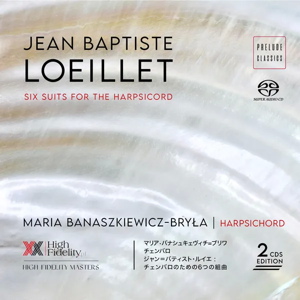
Maria Banaszkiewicz-Bryła harpsichord
111:24 (2 CDs)
Prelude Classics PCL2400701
It has to be said that when I put on the first of this two-CD set, I was instantly impressed with the wonderful clarity of the sound. On further reading, I discovered that it is an example of ‘hybrid multichannel super audio’ of which much more detail in the copious programme notes for those interested in this aspect. Details of recording venue and method have been carefully considered by sound engineer and producer Michal Bryła, evidently a team effort! I wanted to make the point that for one not primarily interested in the recording process, the results spoke for themselves. Another important factor in the rich sound is the instrument Maria Banaszkiewicz-Bryła plays, a fine modern copy by Reinhard von Nagel after a Blanchet original of around 1730. It has a wonderfully rich voice and a rewarding range of stops, which the player uses to great effect. Her playing throughout these demanding works is unerringly musical and expressive, and above all, intelligent. Given that Loeillet advertises his Suits as being ‘in most of the keys’, I wanted to know a little more about the tuning of the harpsichord than was provided by the CD notes. Loeillet also highlights ‘the variety of passages (passaggi) and variations’, suggesting that his Suits are a training ground for the would-be improviser – music of any period, which includes written-out ornamentation, is a treasure trove for performers, and indeed this is the case with these Suits. A pleasing blend of the French and Italian styles, they develop in format – the first three contain an Aria along with the traditional Allemande, Corente, Sarabanda, Minuet and Giga, whereas the concluding three replace this with a Gavotte. Recorded in Poland by a Polish musician and a Polish recording team, this package, with its superb international CD notes and superlative sound, is a powerful testimony to the growing importance of Poland as a centre of historically informed performance and recording.
D. James Ross