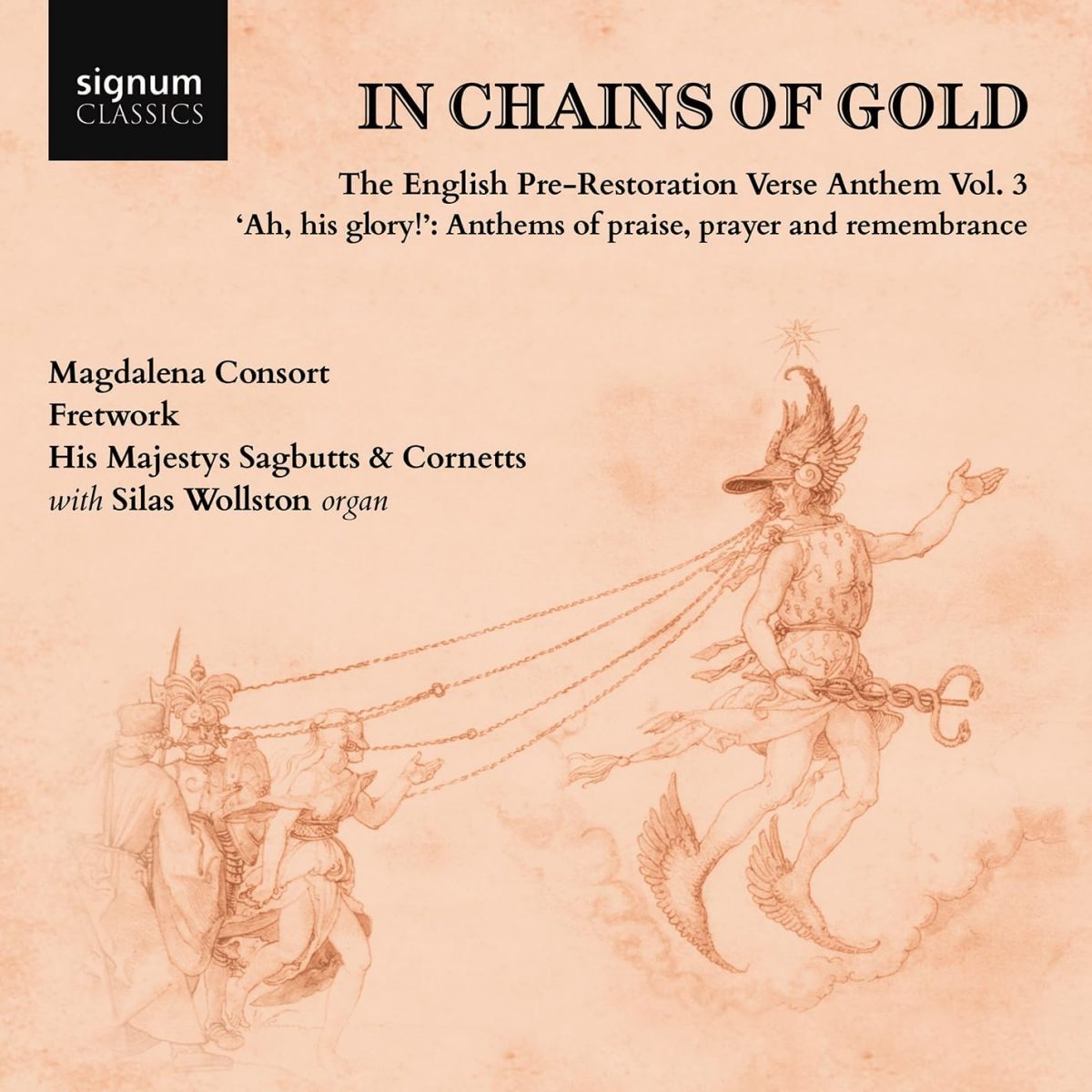
The English Pre-Restoration Verse Anthem vol 3
Magdalena Consort, Fretwork, His Majestys Sagbutts & Cornetts
Signum SIGCD931
83:39
This third volume in the excellent “Chains of Gold” series entitled Ah His Glory: Anthems of Praise, Prayer and Remembrance brings together three leading ensembles, the choral group the Magdalena Consort, the viol ensemble Fretwork and the wind consort His Majestys Sagbutts and Cornetts in performances of verse anthems composed before the Restoration of Charles II. These consort anthems, as they are probably more accurately termed, were composed partly during the reign of Charles I but also during the ‘distracted times’ of the Civil War and the ensuing Protectorate and are generally on a modest scale with the notable exceptions of the lavish setting of This is a joyful, happy holy day by John Ward and Know you not by Thomas Tomkins, which respectively open and close the programme. The former was written in the reign of Charles I, the latter during the Protectorate and probably written by the aging Tomkins more in hope than expectation of performance – his chosen texts mourning a fallen Prince were hardly ‘on message’ for Cromwellian England. There is a wonderful clarity about these accounts by the Magdalena Consort and Fretwork – the more intimate numbers achieve a perfect balance between the voices and viols, while the two larger-scale works incorporating the wind instruments manage to sound wonderfully opulent without any loss of definition. The concluding work by Tomkins is a tantalising taste of ‘what might have been’ in the history of English music if Puritanism had not triumphed so thoroughly. Tomkins was clearly aware of the magnificent music for voices and instruments being composed in Italy at the time, but here is a distinctively English voice using these rich textures to express a distinctively English idiom. A number of less well-known composers are also represented here – John Amner, William Stonnard, Richard Nicholson, William Pysinge and Simon Stubbs – a reflection of the decentralisation of music-making to the provinces at this period of disruption, where music collections had more of a chance of surviving warfare and puritanical purges. Reflecting the limited resources available, this music is on a much more modest scale, but is nonetheless expressive and beautifully crafted.
D. James Ross