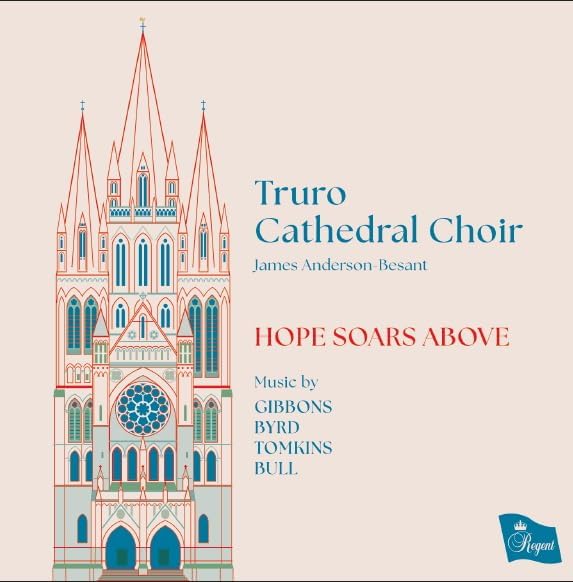
Truro Cathedral Choir, James Anderson-Besant (Director of Music and Organist), Andrew Wyatt (Assistant Director of Music)
Regent REGCD599
56:38
Just when it seemed that the quatercentenary of Orlando Gibbons’ death would slip by with little discographical attention, two fine recordings featuring his choral music
have been released during November. A review of the disc consisting entirely of Gibbons’ music sung by The Choir of the Chapel Royal, Hampton Court Palace, was reviewed in EMR last month. The recording under review here features his music beside works by three of his most eminent contemporaries.
There are four works by Gibbons himself: a verse anthem, a fantasia for organ, and two evening Services, one a verse setting, the other full; both settings consist of the
usual two canticles, Magnificat and Nunc dimittis, providing six individual pieces. The verse anthem is O thou the central orb, the modern contrafactum of what was originally O all true faithful hearts but furnished with nineteenth-century words to offer a more general application, the original text having expressed thanks for King James I’s recovery from illness. Soloists from all four voices – treble, alto, tenor and bass – are required, as is an accompaniment for the organ. Similarly the expansive Second Service calls upon soloists from all voices with organ accompaniment. The Short (or
First) Service on the other hand is for voices alone and is a more succinct setting than the other. Gibbons’ piece for organ is the famous Fantazia of foure parts.
That was the easy bit. Now the controversy. Also attributed to Gibbons is the anthem for six voices Out of the deep. However, this is now considered to be an early
composition by Byrd. Three pre-Reformation sources provide attributions, of which two are to Byrd and only the third – merely an entry in an index – is to Gibbons.
There is also evidence within the music that the anthem is more likely to be an early work by Byrd. But the attribution to Gibbons has proved adhesive, and this is because the collected edition of Gibbons’ anthems (in Early English Church Music) was published several years before the similar volume of anthems by Byrd (in The Byrd Edition) and so the attribution to Gibbons took hold (three recordings, two predating the earlier recording attributed to Byrd) while the revised attribution to Byrd (two recordings) has taken time to seep through to general usage. Without going into
so much detail, the notes in the accompanying booklet, which are excellent throughout, by Alan Howard, reflect this dubiety surrounding the attribution to Gibbons. Notwithstanding the identity of the probable composer, and the early stage in his career when probably he composed it, the work is comfortable in this elevated company. It is the sort of piece which can be dismissed by some editors and
musicologists, whereas in performance it comes across effectively, and is anecdotally appreciated and enjoyed by singers – consider for instance the extended heartfelt outburst at “and with him is plenteous redemption”.
Incontrovertibly by Byrd is his anthem Sing joyfully, also for six voices, his most recorded sacred work in English, particularly popular in the USA, and as Alan Howard observes, an effective emotional counterweight to Out of the deep. The other (third!) work on this disc by Byrd is his well-known fantasia in C, A fancy for my Lady Nevell.
John Bull is enterprisingly represented not by one of his many fine works for keyboard but rather by his verse anthem Almighty God which by the leading of a star known to contemporaries as “the starre anthem”, a star anthem indeed, and one of only a handful of sacred works by him known to survive.
And to conclude the disc Truro includes two works by the greatest composer born in Wales, Thomas Tomkins. Both are sombre masterpieces: his great A sad pavan for these distracted times and one of the finest of all anthems in English Almighty God the fountain of all wisdom, its beautiful harmonies and melodies seasoned with a sudden profound and penetrating exploitation of dissonance, all followed by an Amen which can truly be described as divine.
Although all these works have received commercial recordings already, such is the quality of the music and, thankfully, of the performances that it is all worth hearing in these fine performances, however familiar one is with some or all of the works. For instance, Byrd’s Sing joyfully boasts no fewer than 35 current recordings on the Presto website, yet one would not want to be without Truro’s rousing yet sensitive rendition, with its resounding yet perfectly balanced final chord. The sleevenotes specify which treble line (14 boys, 13 girls) sings in which piece – both lines are excellent and they join for Out of the deep which has two treble parts, and for Gibbons’ Short Service. The 13 layclerks – five altos (two contraltos, three countertenors), and four each of tenors and basses – do a similarly good job on the lower parts. All three organists play a solo. Organ scholar Jeremy Wan plays Tomkins’ pavan – omitting the repeat of the second strain; assistant organist Andrew Wyatt plays Byrd’s fantasia; and in his first commercial recording as Cathedral organist James Anderson-Besant plays Gibbons’ familiar fantasia, but when it is played as well as this there can be no complaint about its inclusion. This is Anglican
cathedral music at its best, a credit to James’s predecessors, Andrew Nethsingha and Christopher Gray, in nurturing the tradition at Truro, and to the current choir and organists in sustaining it.
Richard Turbet