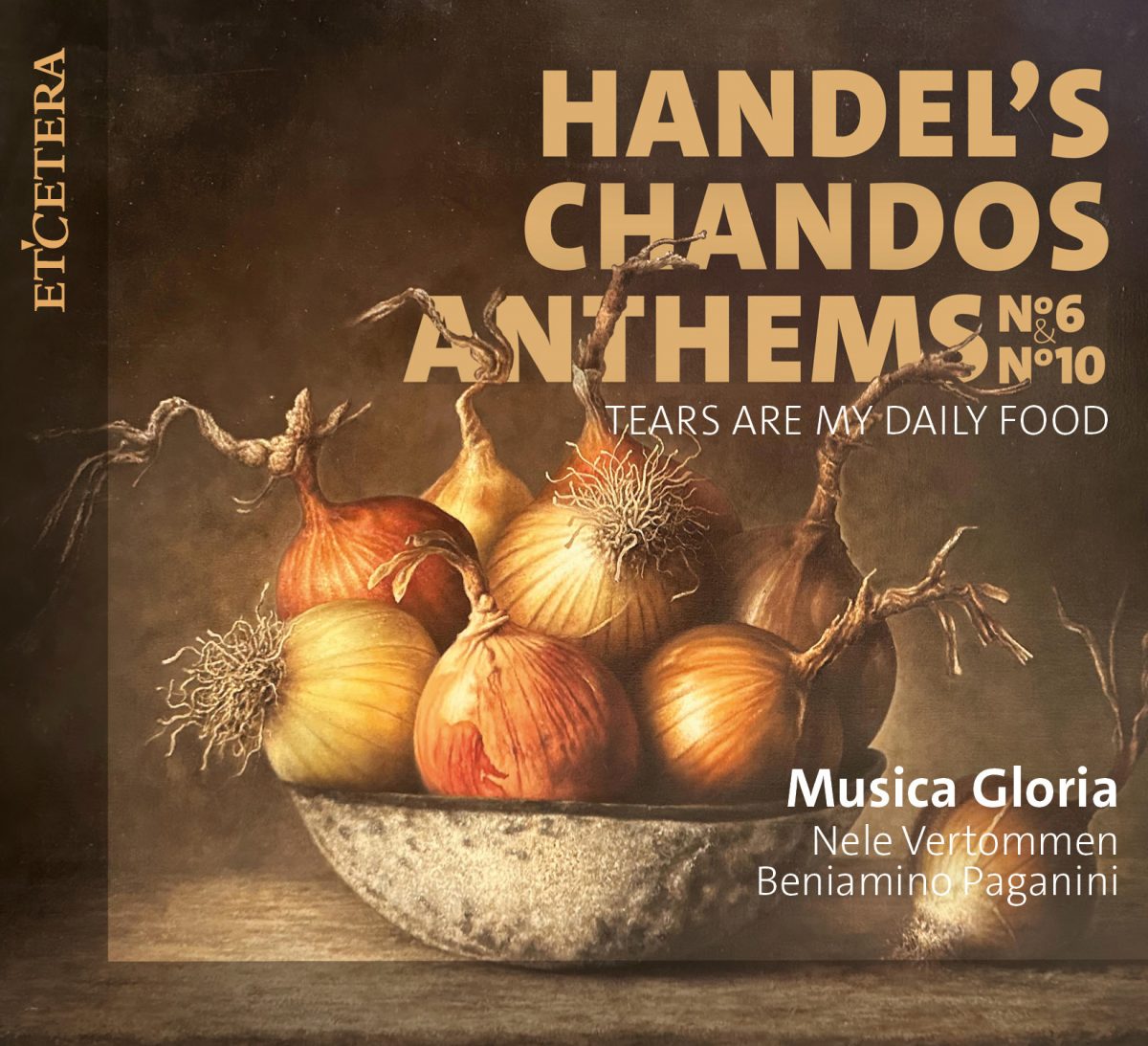
Musica Gloria, directed by Nele Vertommen oboe, and Beniamino Paganini harpsichord/organ
54:47
Et’cetera 1858
Musica Gloria is a young Netherlands-based vocal and instrumental ensemble whose CD ‘Georg Österreich’s Resurrected Treasures’ I welcomed warmly on this site. For their latest recording, they’ve moved forward around 30 years to give us two of the eleven anthems Handel wrote for James Brydges, shortly before he became Duke of Chandos in 1719, during his time with Brydges as resident composer (Johann Pepusch, another German émigré, was director of music). It is sobering to recognize that, had Brydges been alive today, he would almost certainly have been destroyed by the media. He elevated his country house Cannons (near Edgware) to a magnificence rarely found in England outside of royalty by means of fraudulently siphoning off large sums derived from his time as Paymaster General. So without it – over half a million pounds – no Cannons, no Chandos Anthems, no Acis and Galatea.
The Chandos Anthems were all written for the modest forces retained by Brydges, a small chorus and instrumental ensemble (without alto voices and violas) that obviously included an outstanding oboist. Here Musica Gloria field two voices-per-part along with pairs of oboes, recorders, bassoon and strings. As with the earlier CD, there is a marked impression that oboist Nele Vertommen is the driving force of Musica Gloria. Not only are her contributions to the anthems the highlights of the performances, but her playing of the solo part in the Concerto in B flat, HWV 302a, is throughout as finely nuanced and technically as assured as could be wished for.
‘The Lord is my light’ (no 10) notably sets a text drawn from no fewer than eight psalms, and ‘As pants the hart’ (no 6), which more conservatively restricts its source material to Psalm 42, are the anthems included here. Like all the anthems, they include contrasting solo and choral verses much in the style of the French petit motet, but above showing a clear relationship with the verse anthems of Purcell, a source and influence surprisingly not mentioned in the CD’s notes. Unfortunately, the performances do not match those on the earlier disc, though they may please those wedded to the Anglican tradition rather more than they do me. Like so much of that type of choral singing, there is a distinct lack of projection and communication, the performances being more concerned with making a beautiful sound than conveying a message. Diction is poor throughout, a caveat that applies equally to solos as it does to choral work. In ‘The Lord is my light’, this point is dramatically made in the mimetic choral writing at the words ‘the earth trembled and quaked, the very foundations also of the hills’, introducing the shuddering effect first used by Lully in his Isis (1677). Here it goes for little. Tempos are not always convincing either. The opening of ‘As pants the hart’ is disappointingly deliberate and understated, so by the time we reach the second, devastating line, ‘Tears are my daily food’, there has been no sense of build-up to those strong words. Obviously, as already suggested, there will be those for whom such things matter little, and they will likely find much to enjoy in the pleasing blend achieved by the beguilingly fresh-sounding voices. But there is more to this music than we are given here, and there should have been more music given on the CD, too. In this day when 80 minute CDs are no longer the exception, a mere 55 minutes is likely to raise eyebrows. So, sorry not to give more of a welcome, but the impression left is that the performers may not have been sufficiently versed in this music to bring a natural empathy to it.
Brian Robins