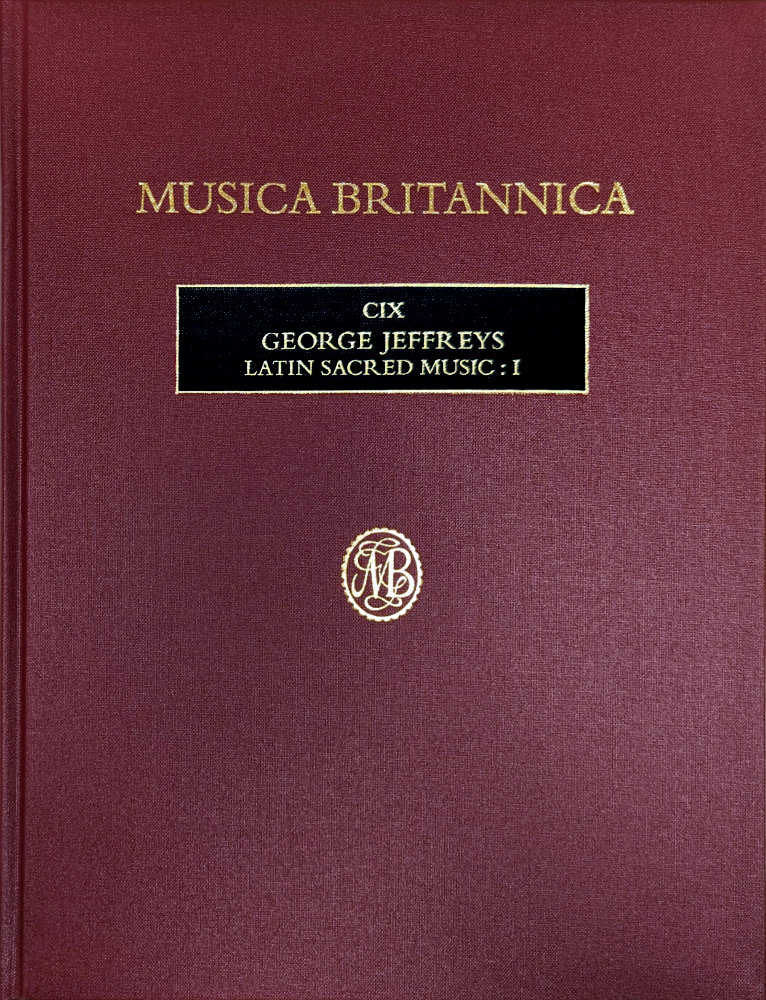
Edited by Jonathan P. Wainright
Musica Britannica MB109
ISBN: 9780852499740 ISMN: 9790220228575
xxxviii + 233pp, £135.00
Stainer & Bell
The full subtitle of this volume is “Liturgical music and motets for one, two and four voices and bass continuo”. The index subdivides the music as follows: Latin liturgial music (two mass movements – the first of them actually for five voices! – and settings of the Venite, Te Deum, Magnificat, Nunc dimittis, and Jubilate Deo), [2] motets for bass voice, [13] motets for two voices (eight of them printed in two versions), and 11 motets for four voices.
The very fine music occupies 198 pages of this typically beautiful Stainer & Bell volume. As an example of Jeffreys’ writing, let us consider a short section from the four-voice Venite exultemus Domino. “Hodie si vocem ejus” begins with solo alto in F major (the “home key” is D major!), answered by the solo bass (“Nolite obdurare corda vestra”) which modulates to A major within five bars; the full ensemble leads (via B major and a circle of fifths back to the home key) to a perfect cadence (“secundum diem tentationis in deserto”) in C major. Quite the harmonic journey!
After 22 pages of detailed critical notes come the full texts with translations. It seems Jeffreys learned to compose “like an Italian” by copying out music that his employers in Northamptonshire, the Hatton family, bought from a London musicseller. This volume, along with the earlier MB CV of English Sacred Music, and (presumably) the forthcoming volume 2 of Latin Sacred Music, will pave the way for more performances of his output, and encourage scholars to investigate Wainright’s assertion that the important role Jeffreys played in bringing the stile nuovo to England has been overlooked.
Brian Clark