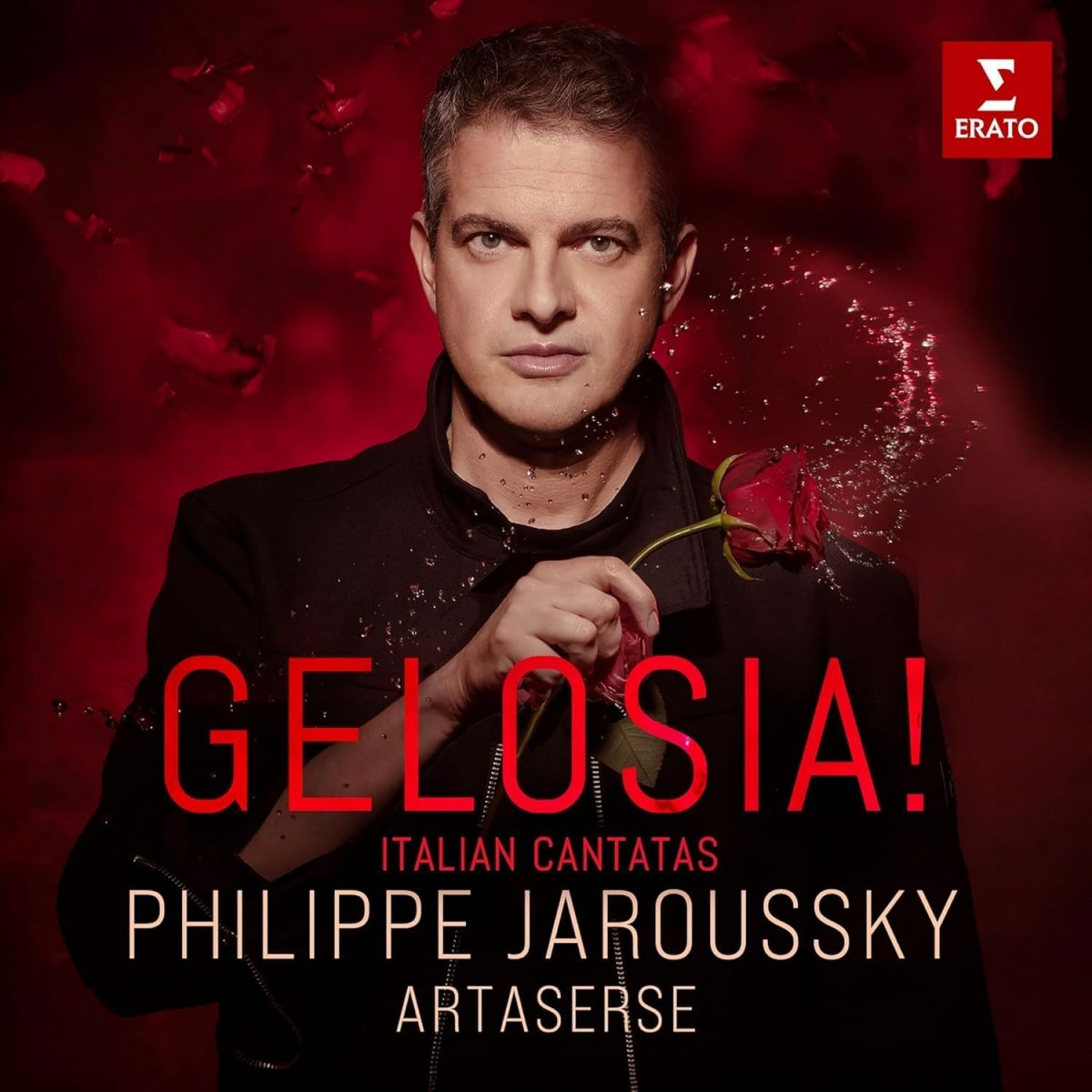
Philippe Jaroussky countertenor, Artaserse
70:58
Erato 5054197998713
The Italian secular chamber cantata was, at its best, arguably the most sophisticated musical form of the Baroque era. Far from being some kind of miniature opera – as performers at times wrongly tend to assume in their approach to cantatas – they explore a world of refined emotional response that does not exclude depth or passion. The audience for such pieces invariably consisted of cognoscenti who expected to hear both poetry and music of the highest quality. It’s a genre that, in many ways, suits the voice and style of French counter-tenor Philippe Jaroussky admirably. The ease of his vocal production is coupled with an ability to shape long cantabile phrases with elegance and articulate passaggi with admirable clarity. The singer’s long experience with this repertoire allows him to bring to it the understanding that added ornamentation requires a greater degree of subtlety than might be applied to an operatic aria. Above all, there is Jaroussky’s unique vocal quality – sometimes wrongly described as androgynous – that takes the listener to a place of security, a place where the singer convinces his audience that he could not make an ugly sound even if he tried to. If that suggests a near-perfect performer, there have long been caveats, too. Jaroussky’s diction in a repertoire that demands textural clarity has often been found wanting, while his lack of a trill is perhaps the greatest single deficit in his technique.
Jaroussky’s choice of cantatas on the theme of jealousy is a particularly felicitous one, including as it does favourites by Vivaldi and Handel, a superb example by Alessandro Scarlatti and, intriguingly, settings of the same Metastasio text (‘La Gelosia’) by Nicola Porpora and Baldassari Galuppi, composed in 1746 and 1782 respectively. The jealousy that forms the overall topic is often of a somewhat studied, pastoral turn, apparent from the names of the cause of jealousy: Filli (Scarlatti), Dorilla (Vivaldi), Nice and Thyrsis (Porpora and Galuppi), Chloris (Handel). This is not the grand, all-consuming jealousy of a Medea, but that of a shepherd who believes his shepherdess has betrayed him. After the cantata has ended, they will make up again, but for its duration, that pain will be keenly enough felt. Perhaps the Scarlatti is the one work here that does not follow such a format. Dating from 1716, it is cast in the form of an ombre scene, its two long passages of accompagnati evoking both literal and metaphorical dark caverns, shadows and fearsome images. The first of the two arias expands this nightmarish scenario, while the final number speaks of how the singer’s betrayed soul will haunt the lover who betrayed him. And here Jaroussky’s pronounced stress on the repeated word, ‘Crudel!’ is highly effective.
The Metastasio text is a different take on the topic of jealousy. Here, in an opening accompagnato – where Porpora demonstrates his acknowledged skill with this type of recitative – the lover pleads forgiveness for falsely accusing his lover Nice of being unfaithful. Porpora follows this with a fully developed da capo aria, a gracious andante in which the lover underlines his newfound trust in Nice. It leans towards the galant style and is twice the length of Galuppi’s equivalent aria. The latter, with its touches of the sentimental style, is texturally more nuanced, and if we might be surprised that Galuppi still chooses to set the by-now old-fashioned poetry of Metastasio, it serves as a pertinent reminder of the esteem in which the poet was held until beyond the end of the 18th century. The second accompagnato brings a dramatic twist. The lover now recalls that Nice is also loved by Thrysis and that she has bestowed on him secretive smiles that were once his alone to enjoy. The concluding aria is a somewhat enigmatic metaphor offering both composers the opportunity for coloratura writing, here executed with practised ease by Jaroussky.
He is supported throughout by his own chamber ensemble Artaserse, here comprising flute (in Handel’s ‘Mi palpita il cor’), two violins, cello, lute (a superfluous addition) and harpsichord, which plays well but is not above some over-fussy decoration. But overall this is a fascinating programme felicitously presented by one of today’s finest artists.
Brian Robins