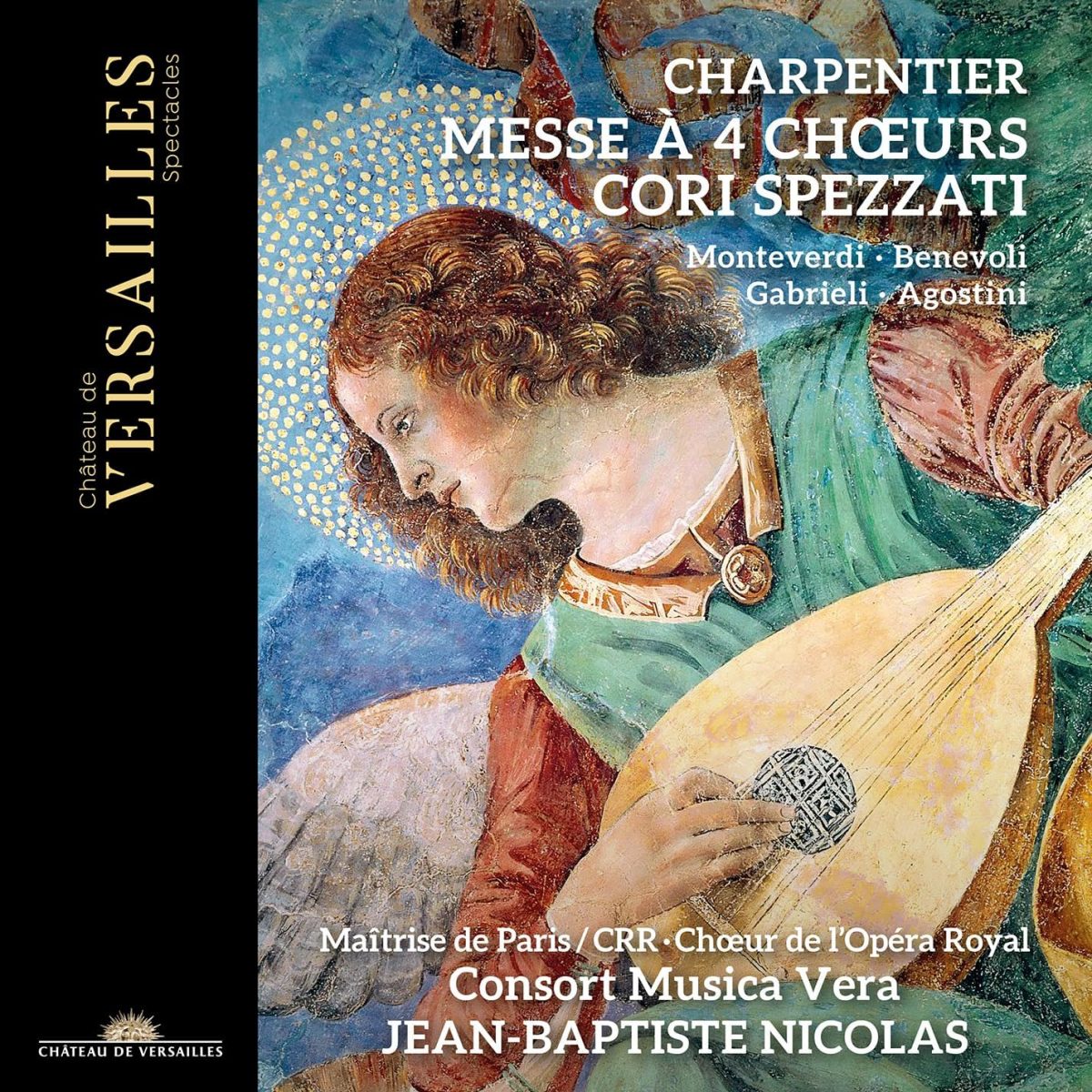
Maîtrise de Paris; Choeur de l’Opéra Royal, Consort Musica Vera, conducted by Jean-Baptiste Nicolas
68:56
Versailles Spectacles CVS164
Although the concept of spatial polychoral works for two or more choirs is particularly associated with the basilica of St. Mark’s in Venice and its many galleries that lent themselves to such works, Rome and other cities, such as Bologna, also developed a strong tradition of performing such spectacular music during the course of the 16th and 17th centuries. Throughout the period, visitors coming to Italy recorded their astonishment at the overwhelming effect that could be produced by music emanating from different locations, and indeed the chori spezzati tradition should surely be viewed as a feature of the counter-Reformation. Oddly, one country that seems to have made no attempt to create its own polychoral tradition was France. The single example of a French composer attempting to emulate it comes from Marc-Antoine Charpentier, with his Salve regina à trois choeurs and Messe à quatre choeurs. For reasons not known, Charpentier visited Rome for a three-year period during his twenties (1653-73), coming into contact not only with a wide variety of liturgical works by such masters of the polychoral tradition as Lodovico Agostini and Orazio Benevoli but also the oratorios of Giacomo Carissimi. Both profoundly affected his development as a composer.
The present disc interestingly compares the Messe à quatre choeurs with a group of works by Monteverdi, Giovanni Gabrieli, Benevoli (who Charpentier almost certainly encountered during his stay) and Agostini. The Monteverdi extracts from the 1610 Vespers, the ‘Sonata sopra Sancta Maria’ – very nicely done by the boys of the Maîtrise de Paris – or the six-part ‘Deus in Auditorium’, with its instrumental reference back to the opening toccata from Orfeo can however hardly be classified as polychoral works. Though born a generation apart, the career trajectories of Agostini (1534-90) and Benevoli (1605-72) follow a similar path, with both having studied at the Église Saint-Louis des Français in Rome. Later, both became music director of Cappella Giulia in Rome, though by that time Benevoli’s career had also taken him to a post in Vienna. The contrasting textures of Benevoli’s 24-part Dixit Dominus, as recorded in the Chapelle Royale in Versailles, seem too complex when taken at such a deliberate pace in a reverberant space, with little separation of the four choirs apparent. It should be noted that the timings for the works that proceed the Charpentier are incorrectly given in the booklet, the 1:26 given for the Agostini Magnificat, for example, more accurately timed at around 6:30.
The Charpentier mass betrays its Roman ancestry from the outset. The opening Kyrie displays the contrasts of texture and weight that are apparent throughout, the solo (petit choeur) opening featuring some lustrous singing by soprano Pauline Gaillard. Here, the entry of the other three choirs is surprisingly and unexpectedly accompanied by timpani. Anyone who has listened to the Italian pieces first will by this time know that loud timpani beats are a feature of the recording and one that conductor Jean-Baptiste Nicolas discusses at length in his notes, noting it is an experiment. Nicolas, who is a musicologist, admits that there is no historical documentation of timpanists being paid for playing church services, but points to examples in painting. Although he argues well and without being dogmatic, I cannot but feel that this is an experiment that has not been successful, indeed one that might have been better suited to a concert than the permanency of a recording. Too often, the entry of timpani comes at the cost of choral clarity or the spoiling of a moment, the most invidious being at ‘Crucifixus’, which follows a transcendent ‘Et incarnatus’, especially touching at ‘et homo factus est’ (and was made man).
I am sure there are those that will find the addition of timpani adds a sense of grandeur and there are indeed some overwhelmingly impressive moments. But I don’t think it works within the context of works that are already giving the listener a considerable aural challenge. Others may find greater satisfaction in the recording of the Charpentier mass – sung within the context of appropriate chant – made by Ex Cathedra (Hyperion, 2003), particularly since it also includes the lovely three-choir Salve Regina. There is also a version by the outstanding Ensemble Correspondances that I’ve not heard (harmonia mundi). But I’m equally sure there are those for whom the visceral excitement of the new Versailles CD will carry the day.
Brian Robins