Categories
Book

Dizionario degli editori musicali italiani. Dalle origini alla metà del Settecento

Edited by Bianca Maria Antolini Pisa: ETS, 2019.
796pp ISBN: 8846753305 €95

Under the auspices of the Società Italiana di Musicologia and the editorial direction of  Bianca  Maria Antolini, 36 musicologists have produced an exceptionally important ‘dictionary of Italian music publishers, from the earliest (in the late 15th century) to those of the  mid-1700s, as a companion volume to the Dizionario degli editori musicali italiani, 1750-1930’ (ETS, 2000). It is far more than a dictionary and even more than an encyclopedia. The main part (600 pages out of 800) consists of 384 biographical entries, many of which are thorough studies on early Italian printers, along with the distributors, financers, composers, promoters and sellers of editions of music. The reader cannot ‘look up’ printing techniques or Italian cities by name, but the extraordinarily useful sections before and after the ‘dictionary’ inform the reader greatly about the protagonists, the developments, and their places in the history of early music and music publication in Italy.

The figures are treated as exhaustively as information warrants. These signed entries are not standardized (as a mere dictionary might require), but organized according to the vicissitudes, relationships, innovations, and importance of each figure, including a specific bibliography. The General Bibliography to sources and research by Chiara Pelliccia is 36 pages long, and the Index of approximately 4,500 names – which may turn up in many different entries – by Maria Borghesi are features of a monographic book of research, not expected in a ‘dictionary’. No doubt some cross-references might have been missed, but these tools are highly useful because printers, composers and booksellers had families, competitors, patrons, and the subject matter gains from treasure hunting exploration.

I was mystified to find ‘Agostino Diruta’ in the Index but not his famous uncle and teacher Girolamo Diruta, the organist and author of Il Transilvano (1593; 1609 and other editions), his treatise and anthology for professional organists, and also the publication with the earliest use of ‘nesting type’ (mosaic characters) in keyboard tablatures. Indeed, three of the ten pages cited for Agostino were not about him, or were about G. Diruta or Banchieri. This is a very minor note of warning about indexes which applies to all books: they may be drafted before the page numbers are definitive, and no index compiler can possibly be an authority on thousands of figures. It is an astounding achievement that this one even gives page references leading to names buried in titles present in the extensive Bibliography!

What makes this ‘dictionary’ also an in-depth history of early Italian music printing is the tripartite introductory section. The three absorbing articles of the first 115 pages – again modestly presented as ‘aspects’, ‘perspectives’ or ‘historical context’ — outline who, where, when, how, why and with what consequences music was published:

The first is Antolini’s, a chronological overview of various aspects of the history of printing music, or inserting music in other types of books, in Italy, from the last quarter of the 15th century on, and especially in Venice, Rome and Milan. She explains the distinction between typographic and xylographic prints, the eventual demand for printing polyphony, and shortly after 1500, for tablatures. As the activity flourished in other cities, the birth of instrumental music at the end of the 16th century made new demands. Manuscripts circulated along with prints, and even manuscript copies of prints; editors specialized in certain repertories, and collaborating figures, sometimes the composers themselves, emerged to produce, finance and distribute music in the 17th and 18th centuries. In her introductory article, we encounter some of the principal names, which many musicians hardly recognize, and the reader is immediately tempted to go to specific entries.

The second article, ‘Da un’altra prospettiva: le tecniche e i processi di stampa della musica in Italia (XV-XIX secolo)’ by Licia Sirch, on the historical printing techniques employed over a span of 500 years, is fascinating for the processes developed. There are no explicit warnings to musicians of the 21st century, but it is clear that we are at risk of not considering the implications of those early techniques. When interpreting printed music, it is imperative to understand the advantages, limitations and purpose of the methods used. Woodcuts were capable of showing anything but slow and expensive to design and cut, and rather rough in appearance. Reusable, they conserved mistakes. Typesetting, the most ephemeral, had vast commercial potential and continued for centuries after the introduction of engraving.

To typeset a page of music, a form with grooves was filled with movable characters (letters, symbols, and notes for every possible value and staff position, each on a separate segment of a staff). Many copies of a page could be printed, after which the form was emptied and refilled with type for a different page. After the print run that page could not be reprinted. We find facsimiles and originals of the same date with differences, however, because the printing could be momentarily halted to change a character. Most pages were never corrected and full of errors. Bulky type (of various kinds), a fixed distance between characters, the lack of beaming, and a limited number of notes per system made the music more widely available than manuscripts, though less accurate and much harder to read. It should be remembered that it was developed for polyphony, to be printed in separate part-books, where a single page or two could contain the instrumental or vocal part for a whole piece.

The ‘mythical’ typesetter Ottaviano Petrucci (1466-1538) had a rival in Andrea Antico (1470/80 – after 1539), a superb wood-cutter. But typesetting prevailed. 16th-century Venetian printers made templates, or ‘standing type’ for successive pages, or for various part-books, into which the characters could be set. This saved some typesetting time, especially when one voice part was graphically similar to another. Not until 1762 did Petronio Dalla Volpe (1721-94) acquire movable composite characters cast as round notes (instead of the previous squares and rhombi) with separate heads, tails, and stems, which could then be ‘nested’ together. Such ‘mosaic’ type was, however, first used by Giacomo Vincenti in 1593 for Part One of Girolamo Diruta’s Il Transilvano (not from Part Two in1609 as Sirch says). Diruta advocated writing for the keyboard in double-staff tablature, with intervals, chords and multiple voices appearing vertically and sharing a single staff per hand.

The highly ornamented ‘new’ vocal and instrumental music of the 1600s saw a great circulation of manuscripts, thereby stimulating a growing use of engravings and lithographs. These resembled fair manuscripts: fast notes could be grouped and beamed; parts printed separately or in score; plates could be stored and reprints made on demand, even with modifications; the contents could be rearranged and included in other volumes. Sirch continues the history beyond the middle of the 18th century. She also includes a very helpful Appendix of terminology to clarify the distinctions between ‘edition’, ‘impression’, ‘emission’ (successive or simultaneously – as separate items or included in anthologies) and  ‘state’ (whether intentionally or accidentally changed).

A shorter article by Saverio Franchi (1942-2014) seems to have almost the same title as the Dictionary itself, but this is misleading. ‘L’editoria musicale Italiana dalle origini al XVIII secolo nel quadro della storia della stampa e dell’editoria’ traces again the course of music printing in Italy, but in the general historical context of  European printing and publishing, which the other studies do not. Franchi was a musicological polymath as well as an important musician. His detailed overview, through his reflections, includes nothing that has come before, and was probably written before all the others! The planning of this bi-partite ‘dictionary’ actually began in 1990, and my hunch is that Franchi’s contribution, published posthumously here, was projected to complement all the others and help readers to place any of the 384 Italian names to be encountered in the dictionary, in the history of Western music.

Barbara Sachs
 

Categories
Book

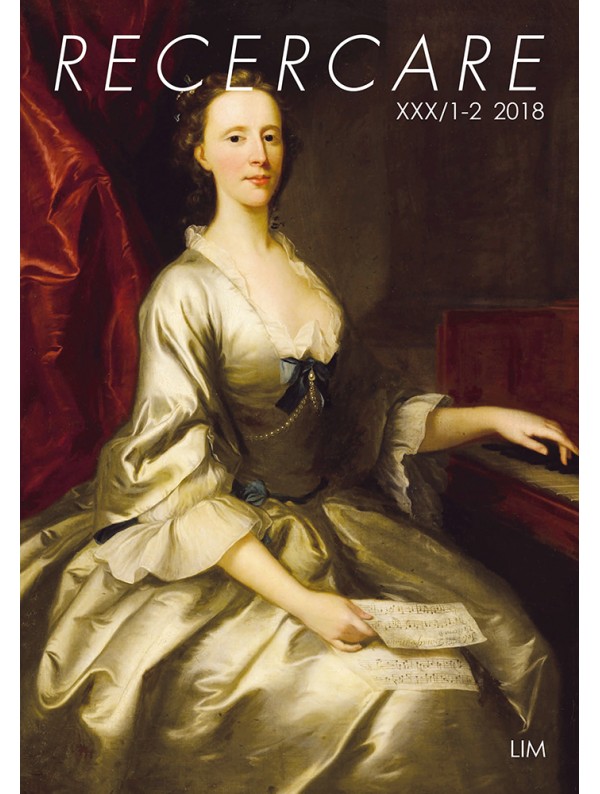
RECERCARE XXX/1-2  2018

Journal for the study and practice of early music directed by Arnaldo Morelli LIM Editrice [2018]
248pp, €30 (€ outside of Italy)
ISBN 978-88-7096-990-0 ISSN 1120-5741
recercare@libero.it
Buy it HERE

Only one study in the current issue of Ricercare is in English; the other seven are in Italian and the summaries appear in both languages. The order, as usual, is chronological, from the 1300s to the late 1700s. Geographically they involve the Veneto, Bologna, Florence and Rome. The journal is dedicated to Italian musical culture, and stimulates research by bringing to light newly examined sources.

In Un elenco Veneto di composizioni del Trecento con inedite attribuzioni a Marchetto da Padova e altre novità Francesco Zimei describes, transcribes and draws conclusions from a handwritten list of titles, originally from the area between Padua and Verona, of 35 mainly sacred 14th-century compositions with their Latin incipits. It is inside the cover of a folder made in the 18th century for containing material on musical theory, and is now in the Biblioteca Capitular y Colombina of Seville. 90% of the pieces listed are missing, but the list itself provides attributions for 80% of the titles. Perhaps previously unattributed music will turn out to correspond to these items, and in any case, from it we will know more about the composers named: Marchetto da Padova, Michael de Padua, magistri Iacobus, Petrus, Iohannes de Florencia, Franciscus de Bononia, and Zenonis.

The article Musica dagli Statuti della Confraternita di S. Maria della Morte di Bologna: ‘letanie, laude et alter oration cum canto digando’ by Gioia Folocamo is about twelve late 14th- and early 15th-century manuscripts of poetry for laude (of which 106 poems are in MS 157 of Bologna’s University Library). What the laude were used for was only recently determined thanks to newly discovered Statutes of a historic confraternity of Bologna that cared for convicts. Lauds were performed for the benefit of prisoners being led to the gallows.

Nicola Badolato’s literary examination of the typical themes and metrical forms of 17th-century Venetian poetry written by librettists for vocal settings is fascinating on various levels – even putting aside the specific works by Ferrari and Fontei used as examples. His study Soluzioni metriche e motivi poetici nei testi intonati di Benedetto Ferrari e Nicolò Fontei gives us interpretive insight into the transition from madrigals to arias, canzonettas, and cantatas, since the poetry was composed to be set to those forms of the time. Poets such as Guarini, Marino, Strozzi, Busenello, Chiabrera, and others, whether in a pastoral or a satirical vein (or both together), composed texts for the composers. One should therefore perform the great vocal music of the period with sufficient appreciation for their styles and forms.

Badolato is a musician, musicologist, and editor of critical editions of librettos and operas, and he has touched on too many elements to sum up without detail. Along the way, however, there are elements useful to performers apart from the technicalities, such as how the discussions held at the meetings of Giulio (and Barbara) Strozzi’s academies (Gli Incogniti and the short-lived Unisoni) were elaborated in music and the themes or topoi encountered in a great number of texts of the time. Singers will recall protagonists expressing their nostalgia for youthful love or refusal of love, the ridiculous expectations for it in the aged, the profound suffering and the brazen desire in others. Timidity and flirtation, love-sickness — with symptoms ranging from blushing and headaches to respiratory and cardiac; the mockery and deceit suffered by the infected; their flights or pursuits; their arming for battle or preparing to die. That these themes were discussed seriously and also made fun of should not be a surprise, given the poetry and music produced. After enjoying the poems included, on a second reading one can also delve into the contrasts of meters, rhyme schemes, and verse forms so appropriately employed.

Badolato missed the opportunity to contrast Monteverdi’s phenomenal setting of the anonymous Voglio di vita uscir with Ferrari’s: namely, that while both set the terza rima as a ciaccona (Monteverdi over variations of his Zefiro bass with continuo solo variations of the ostinato at various points, Ferrari with a straight repetition of a simpler version of the same ground), Monteverdi devoted an entire concluding section to the last four lines, set over descending tetrachords. He thereby contrasted the manic, joyous dance forn with a conclusive, poignant lament, whereas Ferrari simply halted the ostinato, adding two bars of recitative, in which the protagonist makes his last desperate resentful plea.

Antonella D’Ovidio’s article All’ombra di una corte. Lucia Coppa, allieva di Frescobaldi e virtuosa del marchese Filippo Niccolini describes the career of a Roman singer and harpsichord player born in 1625 who had the talent to become a pupil of Frescobaldi from 1635 to 1638. She also studied guitar, as well as singing and counterpoint with Filippo Vitali, and her thorough preparation and success was thanks to the Florentine marquis Filippo Nicolini di Camugliano (1586-1666), a patron active also in Rome, whom she served in his household in Florence. The archive of this aristocratic family, like others not yet explored, yields information on how such virtuosi “served” and what music was performed. According to Severo Bonini (Discorsi e regole sopra la musica, c. 1650 modern edition 1979, p. 113) she was hired by Giovanni Carlo de’ Medici because her playing ‘so leggiadramente’ was like Frescobaldi’s. (Leggiadria – lightness and charm – was specifically construed as applying to the ease in playing ornamental figures, so this source should be noted.)

Every detail of D’Ovidio’s account is telling, as for example, the Appendix. It lists the instruments and music books bequeathed to her by Filippo Niccolini: a highly decorated harpsichord by Domenica da Pesaro with two registers; a curious one containing four spinets (2 x 8’ and 2 x 4’ which can be coupled) for playing duets; an arcicembalo with five keyboards for passing from one mode to every other, invented by Nigetti and made by a son of Nicola Vicentino; another large harpsichord with all possible split keys by Canigiani; a good spinetta; a theorboe and a Cremonese violin. The article does not say if these instruments exist today, but it does say that she had the use of all of them in her music room.

Valentina Panzanaro takes us to Rome, where the Neapolitan violinist Salvatore Mazzella (ca. 1620-1690) played in a trio with Lelio Colista and Michelangelo Rossi. this was noted by Athanasius Kircher in his 1656 Itinerarium extaticum. Mazzella published a collection of dances in 1689, dedicated to Cardinal Fulvio Astalli, and Panzanaro gives a list of the 48 dance movements, four or five per Ballo, with their titles, time signatures, tempo indication, bar lengths and keys. Six are included as examples (most are for violin and basso continuo, in two repeated sections, with figured bass). The last nine are on varied ground basses. They are very short easy pieces, usually a Ballo, Corrente, Giga or Gagliarda plus dances such as Sarabande, Gavotte. Gighe and four Minuette [sic]. One can just make out which ones were actually ‘for’ dancing and which ‘da camera’, the latter typical of the Bolognese style of the 1670’s. They are similar to the sonate da camera attributed to the young Corelli, not mentioned by Panzanaro, but recently recorded, played and published by Enrico Gatti. About both Corelli’s and Mazzella’s one sees a similarity to dances for guitar, ordered into ‘sonatas, elsewhere considered suites’. Being from the south, Mazzella’s publication has a Tarantella of eleven repeatable 2-bar variations, at the end of which one repeats the first half.

In Drammi e oratori nella corrispondenza di Francesco de Lemene con il cardinale Pietro Ottoboni Clotilde Fino first outlines de Lemene’s literary production for other patrons who subsidized operas, oratorios and chamber vocal music in Rome. She then speaks of the projected works realized (or not) for the Cardinal. The correspondence between the Cardinal and the poet-librettist (1634-1704) concerned texts for oratorios – not only for Ottoboni, but also by him, from 1694 to ’98. The last exchanges are the most interesting because de Lemene was not only experienced in writing dramatic poetry for musical settings, but an honest, constructive critic. For example, when asked by the Cardinal for his opinion and suggestions on his work (Oratorio per la nascita del Redentore 1698, set by G. L. Lulier), he replied truthfully, if diplomatically, giving praise where due: an erudite recit of Lucifer was a bit too long, the demons set the scene but there was little ensuing action, and Lucifer could have commanded them to do what they in fact did to molest the newborn in the manger, and how about a reaction from the angels? His remarks give insight about how the librettist conceives, creates and constructs dramatic scenes before the work is set by a composer.

Huub van der Linden’s A family at the opera: the Bolognetti as an audience at the theatres of Rome (1694-1736) is a demonstration of what can be gleaned from studying the ‘paying audience’ frequenting the theatres of Rome. It examines the volumes of one household’s accounts, in this case one aristocratic family who attended and thereby supported (by renting boxes or buying tickets) most of Rome’s theatres. In sheer length and detail it makes one realize how much a comparative or consolidated ‘poll’ of numerous families might yield. That said, it is cumulatively interesting. The family was Ferdinando Bolognetti’s, and the sharing and repairing of boxes (responsibility of the ‘owners’), obviously crucial to a theatre’s management, shows political affinities and financial or social relationships between members of society, and the tastes of the theatre-goers. In addition to the very well-known theatres, the much lesser known Mascherone is mentioned. Van der Linden may not know that Luigi Antinori (1697-1734), a Florentine singer and composer, wrote a satirical cantata which begins with a reference to the Mascherone – La cantante smorfiosa (The carping diva). The soprano, addressing the implicated composer, complains that he made her go to hear the commedia there the night before, after which she caught a terrible cold and fever coming home, and now he expects her to sing.

In Giuseppe Maria Tanfani, compositore e violinista del Settecento fiorentino e inventore del violin tetrarmonico, Bettina Hoffmann rectifies an accidental misspelling of this appreciated Florentine composer’s last name as the far more common ‘Fanfani’, which precluded historians from connecting his activities with his sonatas. His 13 sonatas were correctly attributed to Tanfani in the manuscripts, as was the praise of contemporaries including Quantz, Pisandel, Casimiro degli Albizzi and Nardini. But about his life and other activities nothing was known, since documents in the National Library in Florence had catalogued them under ‘Fanfani’ . (I checked the white pages of the Region of Tuscany: today there are 191 Fanfanis to 2 Tanfanis!) Hoffmann’s suspicion was triggered, and after examining the ‘Fanfani’ documents in which the T’s were misread as F’s, the results turn out to be very interesting. Tanfani (1689-1771 – not ‘1779’ as both summaries give) was active as a violinist and as an inventive violin maker.

The manuscript containing his 12 sonatas for violin and basso, six da chiesa and six da camera, (I-Fn Magl. XIX, 198) is well described, including the folio recto and verso numbers for each sonata. As the study shows a photo of the opening Largo of the first sonata, in D minor (confirmed by the following description), the reader may be momentarily confused by the prior reference to it ‘in Re magg.’ This typo may have occurred because, coincidentally, another, separate sonata of Tanfani’s is indeed in D major: one extant in a manuscript in Dresden copied by Pisendel around 1717, and in another in Cambridge (formerly belonging to F. T. Arnold) in the hand of one of Vivaldi’s scribes, from 1725 or after.

The sonatas, while certainly good music, are typical. Absolutely original was Tanfani’s work as a violin maker. Readers of Italian can read the detailed description and purpose of his violin tetrarmonico. This document, in the Appendix, from 1722 or after, is ostensibly by a friend of Tanfani’s, but it is probably by Tanfani himself. By writing in the third person, he could praise the builder and his invention, and coyly avoid giving away exactly how this new violin worked: it has to be seen to be understood. Its purpose is tantalizingly laid out. ‘Tetrarmonico’ has nothing to do with pure intervals or the differences between diatonic and chromatic semitones. The instrument was designed to be playable in the normal violin repertory by all violinists, but also to allow composers to write notes a fifth lower, without losing the timbre, balance and sonority of the violin. It had a C string a fifth below the G string, probably of gut overlaid with silver thread, as well as 12 extra strings under (sottoposte) the five to be bowed. Of these seven are diatonic and five chromatic, each tuned to resonate with one of the 12 semitones. Not much is given away!

A further mechanism of ebony makes one think of the effects added to keyboard instruments to alter the sounds: instead of having to stop playing in order to place or remove the mute from the bridge, a lever operated by the chin while playing could place and remove it. It applied three levels of pressure: the first sordina, to dampen or mute, the second to vibrate like the low bowed string instrument known as the tromba marina, and the third to mimic a piccolo flautino perhaps raiseing the pitch by an octave.

Sadly, if Tanfani did compose for this instrument, no such music has yet been found. But now researches can look for references under his real name!

Barbara M. Sachs

Categories
Book

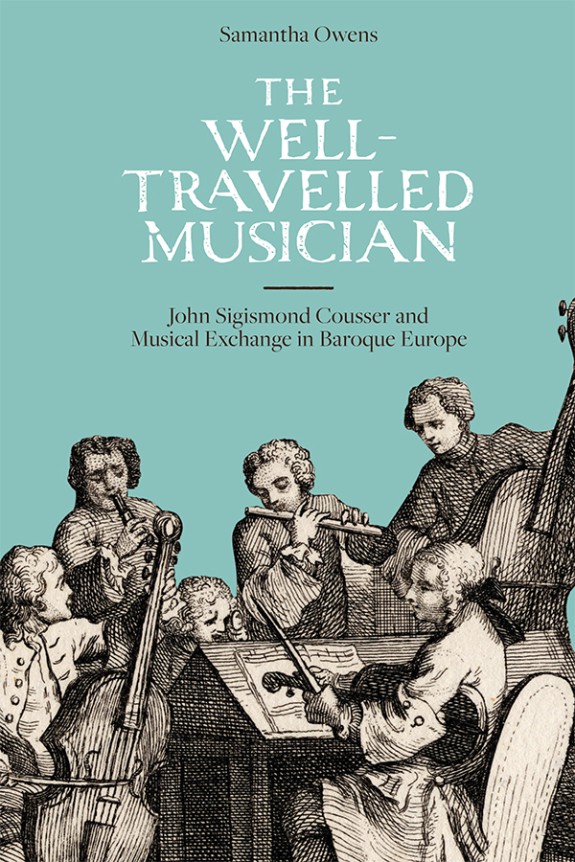
The Well-Travelled Musician

John Sigismond Cousser and Musical Exchange in Baroque Europe
Samantha Owens
xvi+385pp. £60 (hardback), £19.99 (eBook).
Boydell Press, 2017. ISBN 978-1-78327-234-1

Apologies to both the author and the publisher of this extraordinarily detailed book – convinced that I had already published a review, it has lain on my bookshelves for months since… Only when I came to file it away did I realise that, although I had jotted down some notes, I had never sat down at the computer to commit them to public scrutiny.

The first 180 pages of the book are taken up with nine chapters devoted to aspects and/or phases of the composer’s 67-year-long life, each of them oozing the volume of minutiae that in the hands of a lesser writer would have caused brain numbing. Somehow Owens always finds just the right combination of words to maintain enough interest to make the reader want to know more. And there is plenty to learn!

This is nowhere more evident than in her summary of the composer/musician/copyist/impresario’s commonplace book, in her transcription of his Address Book (complete with identifications of almost everyone mentioned!), and in another transcription, this time of notes made on a journey he made in 1716. The latter is little more than a tantalising list of people, music and places but it is just this kind of diplomatic transcription being published that makes other music historians’ jobs easier – somewhere in amongst the seemingly meaningless, someone will find a link that is a crucial part of their puzzle. For this, if nothing else, the world of research into Baroque music owes both Owens and Boydell a huge vote of thanks. Of course, there is much else to absorb and enjoy – the book itself is a thing of beauty.

As the HIP scene in Dublin takes off, Cousser’s music will become more widely known, so get hold of this excellent volume and immerse yourself in his world.

Brian Clark

Click here to visit the publisher’s website.

Categories
Book

I ritratti del Museo Della Musica di Bologna da padre Martini al Liceo musicale

Historiae Musicae Cultores CXXIX
xvii + 684pp €90.00
Leo S. Olschki Editore, 2018
ISBN 978 88 222 6349 0

Most musicologists with an interest in 16th- to 19th-century music will be well acquainted with the extensive collection held in Bologna that once belonged to Giambattista (Padre) Martini, a man more renowned these days for his epic History of Music and reputation as an outstanding teacher of the laws of counterpoint than for his own compositions. That another – equally as impressive and extensive – collection has his name attached to it may be less well known; this time a fascinating array of portraits of musicians (composers, singers, instrumentalists), including celebrated impressions of J. C. Bach, Gluck, Handel, Haydn and Mozart, as well as a far greater number of less well-known characters, and a tantalising selection of anonymous works.

This comprehensive volume provides a thorough background to the collection, including its continued growth after Martini’s death, as well as more detailed studies of individual subjects (such as a chapter on Farinelli). Then it discusses and reproduces 311 paintings (mostly in full colour and slightly under quarter page sized, but some full page) in the main sequence, followed by a further 22 that have been relegated to an appendix for various reasons. The organisation takes a little bit of getting used to: eight chronological sections, each ordered alphabetically (with names beginning with Della listed under D, just in case you wondered!)

I was pleasantly surprised that the volume was not exclusively male; not that there were that many female sitters – one, in particular, caught my eye: Maria Rosa Coccia, who scraped a living as a composer. I may even be inspired to seek out some of her unpublished music. Another portrait once and for all exposes the inaccuracy of an image that is widely circulated on the internet purporting to be Alessandro Grandi; it turns out to be another composer of the same name from a younger generation. (A similar situation surrounds an image of Johann Rosenmuüller, though that has nothing to do with the present book!)

The commentary on each painting (by a variety of authors) is exhaustive from the arts perspective, describing the provenance of each, the accuracy of the identification of both the sitter and the artist, its restoration history and a thorough bibliography.

This book is a very impressive production, as important for art historians as it is for musicologists, and as at home on the shelves of a research library as a coffee table offering for visitors. At such an incredibly reasonable price, it is difficult not to commend it too highly!

Brian Clark

Categories
Book

RECERCARE XXIX/1-2 2017

Journal for the study and practice of early music directed by Arnaldo Morelli
LIM Editrice [2017]. 278 pp, €30 (€? outside of Italy)
ISBN 978 88 7096 9450 ISSN 1120-5741
recercare@libero.it; lim@lim.it – www.lim.it

[dropcap]T[/dropcap]HE LATEST ISSUE of Recercare is quite large. Only one study is in English, but in addition to the summaries in English and Italian of all the articles, there are entire compositions, appendices, documents, plates and references which are useful in their own right. The journal is dedicated to Italian musical culture, and the papers are presented in chronological order by subject matter. They often include in full the documents used. In fact, ‘Recercare’ means ‘to search out’, and the wealth of new material promotes further research, study by study.

Franco Piperno’s short article has a long title, which, translated, would be Ecclesiastic institutions and music in Italy in the early Modern Era: a historical perspective. Actually every one of these words needs to be defined. Italians consider what followed the ‘Middle Ages’ the ‘Modern Era’. This places the Renaissance in the Modern Era, and most of what survives from before that is from after the Middle Ages, and therefore ‘early modern’. Piperno is concerned with two major trends in Italy, where after the Great Schism there was again the Papal state, along with dukedoms, kingdoms or other political authorities, all with local religious institutions. Who ruled and who had control over the religious functions, and for what purpose, was in flux. Piperno wants musicology and historiography to intersect on this question, and he gives examples of the use of liturgical as well as secular music in the 15th century (important for the rise of polyphony) and going a little beyond. Ecclesiastic music, whether controlled by the papacy or preserved in resistance to the centralized Church, may have served spiritual aims or instead been for the show of power, from “above” (chapels of the highest authorities), from “below” (plebs fidelium), and from “in between” (urban centers mediating with the highest circles through bishops and confraternities). So far, attention has been mainly centered on the complex polyphony of the highest institutional levels. Therefore the historical perspective Piperno reminds us to consider invites the study of other types of compositions. He gives examples of where and when the changing contexts surrounding the ecclesiastical institutions affected how music was used.

The article ‘Et iste erat valde musicus’: Pope Leo X, composer, with its Appendix of all his extant compositions, is by Anthony M. Cummings and Michał Gondko. The fuller citation naming Leo X (Giovanni de’ Medici, 1475-1521) goes on to say that he was very musical and composed a (lost) motet, Quis pro nobis contra nos, si Deus est nobiscum, the title of which is close to that of a keyboard intabulation found in Cracow, which might turn out to be based on it. The study entertains the supposition that Giovanni studied with or received guidance from Heinrich Isaac (1450 ca.-1517), the most esteemed composer active at the Medici court, and adduces the fact that the few compositions known to have been composed by Leo X were of types that Isaac wrote. The appendix (pp. 34-52) is a critical edition of Pope Leo X’s opera omnia of four surviving pieces. The newly discovered Benedictus dominus Deus meus for 4vv is quite lovely – 157 semibreves in length, the two upper and two lower voices alternating in long phrases in more florid two-part counterpoint, between sections à4 (DATB). Cela sa[ns] plus is shorter, only 47 semibreves, à5 (DCTTB), without any textual underlay, and therefore possibly instrumental, as is a 3-voiced canon. Readers will want to look into Leo’s biography to appreciate his interests and his patronage of the arts and music, which are not touched upon in this very specific article. The appendix is obviously of use to musicians, irrespective of language.

Rodolfo Baroncini’s study Dario Castello e la formazione del musico a Venezia: nuovi documenti e nuove prospettive is excellent. Many musicians play the Sonate concertate in stile moderno by Castello (1602-1631) but know almost nothing about his life, family, and place in the musical life of Venice up to his early death from plague. Enjoying his music does not necessarily include realizing what distinguishes it historically, and the article may inspire those who have never heard a Castello sonata to do so.

Baroncini has uncovered documents on Castello’s musical ancestors, especially his grandfather, father and his siblings, and the musical circle in which he moved. What he relates is both specific and general. His analysis of the Sonata decima à3 for two violins or cornetts and bassoon or viol (from the 1629 Libro secondo) gives the reader almost the experience of hearing the work: four long musical excerpts, amounting to seven pages of music, are interspersed with very clear, short, descriptions – well chosen and aptly characterized.

What engages in Castello’s music so profoundly and ushers in the new ‘stile moderno’ is not just its sectional form (already common in canzonas and chansons), but its inventively contrasting, developing content – with agogic and dynamic effects, expressive solos, imitations carried over from section to section, and dramatic pacing of tonal harmonies. Some additional short musical examples illustrate other traits. The appendix supplies 32 documents, including the clerical legal investigation to corroborate Dario’s legitimacy in order for him to enter a seminary to complete his musical studies. Others attest to his father’s tragic losses from the plague – that of his second wife, of Dario’s brother and then of Dario, all within a few days. Baroncini makes us feel the loss of a figure we only just came to know something about, since the information he offers is absolutely new.

Orietta Sartori’s article Nomen omen: Giuseppe Polvini Faliconti impresario del Settecento romano, uses a Latin catch phrase to imply that Faliconti (1673 – 1741) was destined by his second surname (that of his mother) to handle the purse strings. ‘Fa li conti’ means ‘[he] does the accounts’, and the impresario ran the four major opera theatres of Rome. At his death a chronicler mistakenly thought this was only nickname that stuck. More respectfully, Metastasio called him ‘the gardener of Parnasso’, his ‘produce’ being poetry, music and good pay to the artists, a compliment he merited. He was greatly respected, though he died deeply in debt, along with his patron, Cardinal Pietro Ottoboni.

Four caricatures of him, drawn by Pier Leone Ghezzi between 1721 and 1730 in the painter’s typically unflattering satirical style, are included and attest to their long friendship. In the numerous productions he organized between 1719 and 1741 he found the librettos, hired performers, arranged sets, directed rehearsals, raised funds and handled marketing. The study follows his career year by year, opera by opera, scene by scene, including events befalling some productions, illustrating in some detail a chapter in the history of opera in early 18th century Rome.

Paolo Russo takes us into the French philosophical aesthetic debates of the late 18th century, as applied to opera, in Tra declamazione e pantomima: Metastasio riconcepito. Charles-Nicholas Cochin, a painter, engraver and intellectual, an admirer of Metastasio’s drama and of the Comédie Italienne, and strongly against the endless recitatives of Gluck and the attempts to restore ancient lyrical tragedy, was the anonymous author of a 1779 pamphlet, entitled Pantomime dramatique, ou Essai sur un nouveau genre de spectacle. Cochin proposed to take Metastasio’s historical subjects, underline the true psychological passions represented, revising, cutting and translating the original versions in such a way as to produce a coherent spectacle combining mute gestural pantomime, declamation (spoken recitation), sung recitation, and arias. The dramatic pantomime, a proto-language, would express passions and would take the place of huge segments of the original texts; declamation, between spoken and sung, would be useful for dialogues, and could be both realistic and harmonious; recitative would blend into the arias, which would constitute the most important parts of the operas, conserving the parts of the original librettos intended as such. Russo prints six scenes from Metastasio’s Demofoonte marking in bold the drastically few lines that Cochin would make use of. The article touches very briefly on what followed in the decades after the debates, but does cover in some detail how other philosophers (Diderot, Voltaire, Rousseau et al.) approached the questions, with direct quotations only in French.

In ‘Respinto da un impensato vento contrario in alto mare’: Anton Raaff, il Farinelli e la Storia della musica di Giambattista Martini, Elisabetta Pasquini documents, mostly through letters, the tribulations that nearly prevented the publication of the first volume of ‘Padre Martini’s’ monumental, if uncompleted, History of Music. Giovanni Battista Martini (1706-1784) was a composer, musical theorist, critic, musical historian and teacher, visited by composers who flocked to Bologna to study counterpoint with him (the most famous being J.C. Bach, Mozart, Gluck and Jommelli). He amassed a musical library, according to Burney, of some 17,000 items, and through his research he aspired to cover the story of music from Adam to his day in five volumes. The 1st volume – ending with music of the Hebrews before the destruction of the Temple and the second exile – was ready to be printed in 1752, and came out, not in 1757 as the title page says (see https://archive.org/details/storiadellamusic00mart/page/n7), but at the end of 1760; the 2nd and 3rd volumes – on ancient Greek music – in 1770 and 1781; the 4th was intended to cover the early middle ages up to Guido d’Arezzo, some parts of which were written. The three published volumes constitute, in themselves, a milestone in the history of music, achieved by great sacrifice and reliance on persons collaborating to obtain patronage to cover the considerable costs.

The ‘official’ 1757 date of dedication of the first volume is still the one generally given, if only because the actual date and the mystery of the need to fake it, which Pasquini has unraveled, persist. It is not a spoiler to say that for economic reasons a royal sponsor had to be found to produce and market in sufficient quantity such a precious, illustrated work (hundreds of pages, with incisions and musical examples, tables, indices, even errata corrige). Lengthy negotiations were undertaken by loyal friends of Padre Martini in Spain, including Carlo Boschi, the famous castrato a.k.a. ‘il Farinelli’ (1705-1782), and the German tenor Anton Raaff (1714-1797). Farinelli was at the court of Maria Barbara of Braganza, Portugal, Queen Consort of Spain (1711-1758) and Ferdinand VI, for decades, up to 1759. (She, of course, was taught by Domenico Scarlatti and received manuscript copies of almost all of his sonatas, later preserved by Farinelli.) Their mission, however, was not successful until the end of 1760, after both Maria Barbara and Ferdinand VI had died. Padre Martini could not have published the eagerly awaited first volume at all without their patronage, so in the end it had to appear to have come out before Maria Barbara’s death. The account is followed by a 32-page appendix of the relevant, critically edited, correspondence to and from Padre Martini, from 1750 to 1773. Pasquini sustains the suspense – others had to intercede, success was uncertain – and the reader shares what must have been an agonizing situation, above all, for Padre Martini himself. For this paper and others by her see also https://unibo.academia.edu/ElisabettaPasquini.

In the New books and Music section of this issue Arnaldo Morelli, Chief Editor of Recercare, writes a long review of all the acts of a convention in Rome in 2015: La Comedia nueva e le scene italiane nel Seicento. Trame, drammaturgie, contesti a confronto, edited by Fausta Antonucci and Anna Tedesco, published by Olschki (2016).

Barbara M. Sachs

Categories
Book

Fasch und die Konfessionen

Bericht über die Internationale Wissenschaftliche Konferenz am 21. Und 22. April 2017 im Rahmen der 14. Internationalen Fasch-Festtage in Zerbst/Anhalt
Fasch-Studien 14
Ortus Verlag om243. 432pp. €40.50
ISBN 978-3-937788-58-6

2017 MARKED THE 500TH ANNIVERSARY of the beginning of the Reformation. Martin Luther, whose Wittenberg Theses set the whole thing in motion and who, to a very large part single-handedly, established the liturgy (including its music) of the church which still bears his name, had very close connections with Zerbst, so it was thought appropriate to theme the conference that took place there during the Fasch Festival that year against a religious background. At various points in his life, the composer was employed by Catholic and Protestant nobles, and struggled with his own Pietist beliefs which were considered heresy by the Anhalt court censors. The present volume includes the texts of the 13 papers given, a comprehensive index and biographies of the authors.

Michael Maul opened proceedings with an introduction to the development of musical establishments within the Lutheran church; likening the push to educate boys in the art of singing to Germany’s determined efforts to rebuild their football team after a disastrous World Cup competition, he portrayed Luther’s drive as political expedience and a formative influence on the way music held a central place in the new church. Jan Brademann then explained developments in Zerbst where the court remained Lutheran while the town adhered to the Reformed church and the reaction of both to the rise of Pietism (of which Fasch was a proponent) and the consequences for musicians.

An important figure in the early 18th century was Johann Baptist Kuch; Rashid-S. Pegah took over 50 pages to fill out his biography and details of music in Zerbst immediately before and during his tenure as Capell Director. After several readings, I still feel I have not absorbed all the information he gives! Gerhardt Poppe’s paper focuses on Fasch’s settings of the mass for Zerbst. His studies of the Dresden chapel repertoire are well known, but there are clear gaps in his knowledge of the Fasch literature; firstly, [now Dr] Maik Richter was certainly not the first person to recognise the regular use of mass movements in the Zerbst liturgy; secondly, the Latin movements were not replaced by German hymns on the third days of Christmas, Easter, and Whitsun, but by settings of the German mass text (of which there were two settings in the “Zerbster Musikstube”); and thirdly, as I explained to him at the conference, the chronology of the F and G major versions of the mass known as FR 1260 is reversed, so movements he calls “new” in his analysis are actually “old”…

Gottfried Gille surveyed the contents of the surviving editions of the Zerbster Gesangbuch, the bespoke hymn book used in worship throughout the principality, including discussions of local poets whose works are included. My own paper focused on a set of part-books that contained music for an annual cycle of chorales; the fact that the text of the first was by one of the local poets Gille had identified (Johannes Betichius) led me to realise that the chorales were those Fasch used in 1738 to craft two cantata cycles from a single cycle. The only cantata from the cycle that had survived (without the central chorale!) was performed in its 1738 version in the church service that took place in the Bartholmäikirche on the Sunday after the conference.

The next four papers investigated figural music in the court chapel. Nigel Springthorpe’s “Roellig in charge” set out to establish which cycles were performed in which years, and Marc-Roderich Pfau introduced details of a cycle by Christopher Förster. Beate Sorg and Evan Cortens are recognised Graupner specialists: Sorg explored his contributions to the so-called “Dresden Jahrgang”, which Marc-Roderich Pfau had postulated Fasch compiled in advance of his sabbatical in the Saxon capital, and challenges some of Pfau’s conclusions. Cortens sought to demonstrate how the musical origins of Neumeister’s “new” cantata form lay in the opera house, and argued that the crippling financial impact of even attempting to maintain such an institution was alleviated by moving the musical style into the liturgical sphere.

The final three papers concerned music for funerals. Barbara Reul established the format of funerals in Zerbst and produced new evidence about the locations where such things were held. Irmgard Schaller’s focus was on the texts written (and printed) for such events. From a Fasch perspective, perhaps the most important revelation came in Maik Richter’s paper which introduced a series of letters he had found in the Cöthen court records concerning music that he was commissioned to write for a funeral there that (in conjunction with his previous archival research that had established that Fasch was paid for birthday and New Year cantatas) suggest that he was pretty much considered the Kapellmeister for all of the Anhalt lands. Personally, I see no point in speculating which musicians from Zerbst might have taken part in the services in Cöthen. On the other hand, it is invaluable to have the full texts of the three cantatas, and – obviously – to have letters in which the composer explains how he will set about dealing with the texts he had been sent.

Such a fine volume – handsomely printed by ortus verlag – could not have been produced without an enormous amount of editorial work; two former presidents of the Internationale Fasch-Gesellschaft e. V. (Konstanze Musketa and Barbara M. Reul) are to be commended for seeing another fine volume of Fasch-Studien through the press.
Brian Clark

Categories
Book

Johann Ernst Bach: Thematisch-systematisches Verzeichnis der musikalischen Werke

Bach-Repertorium: Werkverzeichnisse zur Musikerfamile Bach, Band VI
168pp.
Carus-Verlag 24.206/00
ISBN 978-3-89948-284-3 €78.00

[dropcap]P[/dropcap]ublished in collaboration with the Research Project of the Saxon Academy of Sciences in Leipzig, located at the Bach Archive Leipzig”, this latest instalment of the 11-volume series of “thematic-systematic” catalogues of the known works of the members of the Bach family other than Johann Sebastian (1695-1750) breaks the output of Johann Ernst (his nephew, 1722-77) into nine categories: keyboard works, chamber music, symphonies, oratorios and passions, liturgical church music, church cantatas, secular cantatas, songs and motets (which are labelled A–H, with the suffix “-inc” if there is reason to doubt the attribution), and spurious works (Y). There is not a huge amount of music (although he was Kapellmeister and organist at Eisenach, he seems to have been more active as the court lawyer), so – for example – Section C: Symphonies has an introductory page (quoting Gerber’s assertion that Bach wrote “many symphonies”) and a second page with a single entry, detailing its unique source (currently in North America!) The Passionsoratorium entry is based on the modern edition, since the whereabouts of the original has been unknown since 2007. Liturgical church music covers a Missa brevis  on the melody “Es woll uns Gott genädig sein” (mistakenly catalogued elsewhere as TVWV 9:8), and three settings of the German version of the Magnificat text. As one would expect from such a prestigious line-up of musicologists and publishers, the book is both packed with immense amounts of information that will undoubtedly contribute to a wider understanding of JEB’s output (and facilitate the identification of further works by him!) and a beautiful object in its own right. At around 1cm thick, its modest appearance belie the enormous value of its contents.

Brian Clark

[iframe style=”width:120px;height:240px;” marginwidth=”0″ marginheight=”0″ scrolling=”no” frameborder=”0″ src=”//ws-eu.amazon-adsystem.com/widgets/q?ServiceVersion=20070822&OneJS=1&Operation=GetAdHtml&MarketPlace=GB&source=ss&ref=as_ss_li_til&ad_type=product_link&tracking_id=infocentral-21&language=en_GB&marketplace=amazon&region=GB&placement=3899482840&asins=3899482840&linkId=cfd3945d45c60a540609167c9f77056c&show_border=true&link_opens_in_new_window=true”]

[iframe style=”width:120px;height:240px;” marginwidth=”0″ marginheight=”0″ scrolling=”no” frameborder=”0″ src=”//ws-eu.amazon-adsystem.com/widgets/q?ServiceVersion=20070822&OneJS=1&Operation=GetAdHtml&MarketPlace=DE&source=ss&ref=as_ss_li_til&ad_type=product_link&tracking_id=earlymusicrev-21&language=de_DE&marketplace=amazon&region=DE&placement=3899482840&asins=3899482840&linkId=796ed99b5b737a6226972b64942cd458&show_border=true&link_opens_in_new_window=true”]

[iframe style=”width:120px;height:240px;” marginwidth=”0″ marginheight=”0″ scrolling=”no” frameborder=”0″ src=”//ws-na.amazon-adsystem.com/widgets/q?ServiceVersion=20070822&OneJS=1&Operation=GetAdHtml&MarketPlace=US&source=ss&ref=as_ss_li_til&ad_type=product_link&tracking_id=earlymusicrev-20&language=en_US&marketplace=amazon&region=US&placement=3899482840&asins=3899482840&linkId=5004e5d48c0a6bc532f8b557431f7f88&show_border=true&link_opens_in_new_window=true”]

This site can only survive if users click through the links and buy the products reviewed.
We receive no advertising income or any other sort of financial support.

As an Amazon Associate I earn from qualifying purchases.

Amazon and the Amazon logo are trademarks of Amazon.com, Inc. or its affiliates.

Categories
Book Recording

The Art of Fugue: Book AND recording

Martha Cook: L’art de la fugue: une méditation en musique
250pp
Paris: Fayard, 2015
ISBN 978-2-213-68181-8

Bach: Die Kunst der Fuge
Martha Cook harpsichord
73:62 (2 CDs)
Passacaille 1014

[dropcap]T[/dropcap]he Art of Fugue has long intrigued performers and musicologists alike and much time has been spent seeking to explain its genesis and organization. The question is complicated by differences in layout in the two main sources: Bach’s autograph, which originally had twelve fugues and two canons, and a published version, hastily put together by C. P. E. Bach in 1751, which changed the order and added two further fugues and two canons, plus other pieces. Martha Cook has recently written a book, published in French, in which she proposes that Bach built the cycle around eight verses from Luke’s Gospel, beginning at Chapter 14, Verse 27. These numbers correspond to the gematrial equivalent of J. S. Bach’s name (27+14=41). Cook also noticed that the opening words of Luke 14:27 in German ‘Und wer nicht sein Kreuz trägt und mir nach folgt’ can be made to fit the Art of Fugue’s main theme. Her book expands on all of this and finds rhetorical correspondences between the verses from Luke and successive movements of the Art of Fugue (in its original order) which has led her to accept the plausibility of this theory of origin. While Bach’s deep knowledge of the bible and his interest in numerology are well substantiated, the evidence for a biblical genesis of the Art of Fugue is largely circumstantial and, to my mind at least, not ultimately convincing. Another recent theory, propounded by Loïc Sylvestre and Marco Costa (in Il Saggiatore Musicale  17 (2010), 175-195) and based on bar numbers, suggests that the whole structure is based on the Fibonacci sequence, an intriguing but again circumstantial explanation.

[dropcap]U[/dropcap]ltimately it is the music that counts and, while Cook’s theory must have informed her preparation for this recording, there is nothing about her playing or her interpretation which follows directly on from it. Indeed, while the theory would have suggested recording just the autograph version, Cook (while using its order) incorporates the two extra fugues and canons from the print but omits the two mirror fugues; this presents us with an odd hybrid. It is, of course, very unlikely that the Art of Fugue was intended for public performance in one sitting, and listening to it straight through on a single instrument like this can lessen the experience. That said, Cook presents a straightforward interpretation of what she calls the ‘ideal solo harpsichord version’. All the contrapuntal and canonic procedures are very clear in her playing but I find it a bit lacking in expression: the cerebral is emphasised at the expense of the rhetorical or the emotional. She plays a harpsichord by Willem Kroesbergen based on a Johannes Couchet original and uses a temperament reconstituted from an Andreas Silbermann organ of 1719 which works very well. This was clearly a labour of love from Cook and both her book and recording show a deep commitment to the Art of Fugue and its many facets. Both are certainly worth having for their insights into this endlessly fascinating work.

Noel O’Regan

[iframe style=”width:120px;height:240px;” marginwidth=”0″ marginheight=”0″ scrolling=”no” frameborder=”0″ src=”//ws-eu.amazon-adsystem.com/widgets/q?ServiceVersion=20070822&OneJS=1&Operation=GetAdHtml&MarketPlace=GB&source=ss&ref=as_ss_li_til&ad_type=product_link&tracking_id=infocentral-21&marketplace=amazon&region=GB&placement=2213681813&asins=2213681813&linkId=82f7c19abd3bb51b06d5eb6aaa780138&show_border=true&link_opens_in_new_window=true”]

[iframe style=”width:120px;height:240px;” marginwidth=”0″ marginheight=”0″ scrolling=”no” frameborder=”0″ src=”//ws-eu.amazon-adsystem.com/widgets/q?ServiceVersion=20070822&OneJS=1&Operation=GetAdHtml&MarketPlace=DE&source=ss&ref=as_ss_li_til&ad_type=product_link&tracking_id=earlymusicrev-21&marketplace=amazon&region=DE&placement=2213681813&asins=2213681813&linkId=6a0c23fbfe9754e23ec8c17717852187&show_border=true&link_opens_in_new_window=true”]

[iframe style=”width:120px;height:240px;” marginwidth=”0″ marginheight=”0″ scrolling=”no” frameborder=”0″ src=”//ws-na.amazon-adsystem.com/widgets/q?ServiceVersion=20070822&OneJS=1&Operation=GetAdHtml&MarketPlace=US&source=ss&ref=as_ss_li_til&ad_type=product_link&tracking_id=earlymusicrev-20&marketplace=amazon&region=US&placement=2213681813&asins=2213681813&linkId=fc7c284ac9a01fdbcba6e2daa8b55ba6&show_border=true&link_opens_in_new_window=true”]


[iframe style=”width:120px;height:240px;” marginwidth=”0″ marginheight=”0″ scrolling=”no” frameborder=”0″ src=”//ws-eu.amazon-adsystem.com/widgets/q?ServiceVersion=20070822&OneJS=1&Operation=GetAdHtml&MarketPlace=GB&source=ss&ref=as_ss_li_til&ad_type=product_link&tracking_id=infocentral-21&marketplace=amazon&region=GB&placement=B0128ETYZW&asins=B0128ETYZW&linkId=16ba860bb9f5ab6976f8d8ac0dc46677&show_border=true&link_opens_in_new_window=true”]

[iframe style=”width:120px;height:240px;” marginwidth=”0″ marginheight=”0″ scrolling=”no” frameborder=”0″ src=”//ws-eu.amazon-adsystem.com/widgets/q?ServiceVersion=20070822&OneJS=1&Operation=GetAdHtml&MarketPlace=DE&source=ss&ref=as_ss_li_til&ad_type=product_link&tracking_id=earlymusicrev-21&marketplace=amazon&region=DE&placement=B0128ETYZW&asins=B0128ETYZW&linkId=4a35f58b601b85a8916b45619843d838&show_border=true&link_opens_in_new_window=true”]

[iframe style=”width:120px;height:240px;” marginwidth=”0″ marginheight=”0″ scrolling=”no” frameborder=”0″ src=”//ws-na.amazon-adsystem.com/widgets/q?ServiceVersion=20070822&OneJS=1&Operation=GetAdHtml&MarketPlace=US&source=ss&ref=as_ss_li_til&ad_type=product_link&tracking_id=earlymusicrev-20&marketplace=amazon&region=US&placement=B0128ETYZW&asins=B0128ETYZW&linkId=bc0fb1abdbf16bdc9fa7f233d86e08c0&show_border=true&link_opens_in_new_window=true”]

Banner, 234x60, ohne Claim, bestellen

Categories
Book

RECERCARE XXVIII/1-2 2016

Journal for the study and practice of early music
LIM Editrice [2016]. 260 pp, €24 (€29 outside of Italy)
ISSN 1120-5741 ISBN 978 88 70 96 8996
recercare@libero.it; lim@lim.it – www.lim.it

[dropcap]T[/dropcap]he latest issue of Ricercare has two studies in English and four in Italian, counting the shorter report by Francesco Zimei Ars nova disvelata. Sulla restituzione digitale del palinsesto San Lorenzo 2211 alla luce di due studi recentemente pubblicati. At the end there are book reviews of: Raffaele Mellace’s Johann Adolf Hasse  (Simone Caputo), Barbara Sparti’s Dance, dancers and dance masters in Renaissance and Baroque Italy  (Wendy Heller), and Roberto Lasagni’s L’arte tipografica in Parma  (Federica Dallasta).

The principal studies are, as usual, in chronological order by subject matter, this time ranging from the early 1500s to the beginning of the 1700s.

Musica profana a Napoli agli inizi del Cinquecento: i villancicos della Cuestión de amor. Alfonso Colella’s study may be a difficult read at first if the historical context is not familiar. During the Aragonese reign Naples Spanish polyphony and secular song thrived. With the fall of the Aragonesi in 1502 the music changed. The anonymous Neapolitan poetic chronicle, La Cuestión de amor (Valencia, 1513), was probably by Velásquez de Ávila, a poet and musician active in Valencia, Palermo and Naples, and indeed one of the characters in this sentimental historical novel. Parts of the poetic text date back to the 14th century, whereas the descriptions of musical performances, villancicos  and canciónes  for two and three voices, refer to ones performed in a pastoral play, Egloga di Torino, which was public entertainment. The voices alternated in strophes (coplas), singing together in refrains (estribillos). The music was not important to the court, with its emphasis on war and chivalrous values, nor to the love story, the events, or the problem it tackled: who suffers more, one who loses a beloved or one whose love is unrequited. Not surprisingly, then, none of the music has survived. But links between the written Italian frottola  and the less refined unwritten musical tradition of the Spanish villancico  are illustrated, and the interest in la Cuestión  is therefore also musicological.

Worth the price of the Musurgia universalis: Athanasius Kircher on the secret of the ‘metabolic style’. Jeffrey Levenberg, in the title of his study, is citing Kircher’s plug, or teaser, to attract potential buyers of his treatise. Translated from his Latin ‘Truly, if I include examples of this secret … metabolic style… known only to the most skilled … I will make my book worth its price …’ His study (in English) of Kircher’s, is also more than worth the price of Recercare XXVIII, long to be remembered, and possibly commented on. Spoiler alert: Levenberg analyzes the accepted and controversial theoretical components of the ‘metabolic’ style (combining mutations of the modes, transpositions of their finals, and the use of diatonic, chromatic and enharmonic species) and not only compares the exact effects of competing contemporary and modern theories in the notoriously difficult problem of chromatic and enharmonic species, but shows Kircher to emerge on the side of practical musicians playing normal keyboards with mean-tone tunings. Despite the difficulty of interpreting Kircher (whether to defend him or otherwise), this verdict will excite players and encourage the performance of this esoteric repertoire, and of other pieces not as yet considered to belong to it. For the question of tuning, Levenberg’s explanations are clarified by several exemplary tables. In one he goes beyond Kircher to compare Mazzocchi’s division of the whole tone by chromatic, diatonic, and enharmonic semitones with Kircher’s.

John Whenham’s The Messa a Quattro voci et salmi (1650) and Monteverdi’s Venetian Church music  reveals how Vincenti probably acquired this little-known mass and psalms, considered alongside the Selva morale  of 1641, which he published shortly after Monteverdi’s death. Comparison shows how Monteverdi modified previously published works in order to produce others on commission. As maestro di cappella  at St. Mark’s, he was allowed to accept work for other churches, and also to keep his manuscripts in his personal library, for his personal professional use. Whenham shows how the composer would change their beginnings to hide the borrowing, though of course he also revised and altered their length. This would not have been discovered were it not for the 1650 edition. In his defence it should be noted that masses and psalms were generally elaborations of ‘borrowed’ liturgical chants to begin with, and perhaps Monteverdi did precisely what was expected of him. He was also paid significantly, the demand for new polyphonic versions of psalms being high. This glimpse into his compositional process is indeed a rare finding.

Giovanni Rovetta, ‘uno spirito quasi divino, […] tutto lume in nere et acute note espresso’. Paolo Alberto Rismondo‘s study is more about the composer’s life (1597?-1668), family relations, background, and especially his career in Venice, than about his compositions’. Rismondo includes whatever he could into his account as much as possible about the figures with whom he interacted, including Monteverdi (who was maestro di cappella  to the Doge in San Marco when Rovetta was vicemaestro), Cavalli, and others. By subtracting Rovetta’s stated age from the known date of his death he opts for 1597 for his date of birth. Lost church registers from June 1596 to May 1599 make it otherwise unascertainable, even though the index to the baptismal records almost certainly identifies Giovanni as “Zuan Alberto de messer Giacomo sonador barbier”; in fact, his father, Giacomo, was a violinist and barber.

In the title of the article Rismondo quotes from the dedication to a 1668 collection of music by Bonifacio Graziani written by Graziani’s brother, with words of praise for Rovetta espressed by an allusive pun on his name: ‘Who doesn’t admire in you, Giovanni Rovetta an almost divine spirit, like the famous [burning] bush [roveto] of Moses all light expressed in quick and high notes’. The biography continues with Rovetta’s nephew, Giovanni Battista Volpe, who became maestro della cappella ducale  in 1690, and with the considerable diffusion of Rovetta’s music outside Italy. The article gives the impression of reporting everything knowable now from documents or reasonable hypotheses.

Eleonora Simi Bonini  and Arnaldo Morelli  collaborated on the six sections, Appendix, and index of names in Gli inventari dei ‘libri di musica’ di Giovan Battista Vulpio (1705-1706). Nuova luce sulla ‘original Stradella collection’. G. B. Vulpio (c. 1631-1705) compiled and left an immense collection of more than 200 manuscript compilations, which is shown to include the largest collection of Stradella’s works. The article is about Vulpio (a singer in the papal chapel and composer) and his relations with others. The Appendix to the article offers the entire inventory of his collection, as it was organized. It sometimes contains the names of librettists and poets as well as the composers, and usually a description of the bindings, number of pages, etc. The number of works by Stradella includes cantatas, serenatas, arias, operas, many of which autographs. Equally important are those by Luigi Rossi, Carissimi, and Pasquini. One finds Simonelli, Scarlatti, Mazzocchi, Tenaglia, Cazzati, Melani, Bononcini, Gratiani, Carlo del Violino, Carlo Rossi, and others. Only 13 of these volumes are now known for certain to be conserved in various libraries. The search for a couple of hundred of the other volumes must be accelerated: the inventory lists 387 items.

Barbara Sachs

Categories
Book

Vania Dal Maso: Teoria e Pratica della Musica Italiana del Rinascimento

[Teorie musicali, 3] (LIM, 2017)
xxxiii+392pp
ISBN 9788870968880 €28

[dropcap]V[/dropcap]ania Dal Maso is a harpsichordist, musicologist and professor of musical theory. Her repertory includes rarely performed 14th- and 15th-century music, which she plays on very early instruments (including the clavicymbalum, clavicytherium, clavichord and positive organs). Since the line of transmission from medieval to modern music is not a direct one from teacher to pupil, she has researched, written and lectured on musical treatises and the didactic methods of early theorists. The present book is a distilled synthesis of this knowledge and experience, fitting the needs of her students and others.

It presents the underlying theories and resulting practices of Italian Renaissance music by discussing selected subjects as they were covered by various treatises (from Tinctoris and Gafurius in 1494 and 1496 to Lanfranco and Ganassi; from Aaron, Vicentino and Zarlino in the mid 1550s to Dalla Casa, Bassano and Diruta at the end of the century; from Cerreto and Banchieri in 1601 up to the later tracts of Banchieri, Diruta, Zacconi and others). In general, this strategy produces a modern tract that parallels in its own organization the approaches of the authorities discussed. The reader, like a learner of four centuries ago, proceeds from clefs to mensuration, proportions, modality, counterpoint and performance practice. The commentary, however, points out some of the essential ways in which the sources differ, and how the music of the 1500s differs from our mainstream classical music.

A single guide to such a non-homogeneous subject cannot actually give a modern musician the competence to deal in every specific case with solmisation, modal harmony, musica ficta, mensuration, Renaissance counterpoint, the controversial concrete calculation of intervals themselves, improvisation and ornamentation. It aims to offer readers as much guidance as they seek, depending on what they already know and need to know. The first thing to be learned is how interconnected these matters were. It provides bibliographical options for how to proceed in greater depth, where the choices would obviously relate to the music one wants to study.

It is definitely a book for Italian musicians – the curious, serious, or indeed studious. Some of the tables, diagrams and musical examples are helpful in themselves, but still require reading the text. Dal Maso’s writing is as clear as can be, while necessarily dense: she doesn’t have room to say things more than once! I ignored the author’s suggestion that one might read the chapters in any order and even skip some. Everything is integral to the subject. A Renaissance ‘post-grad’, having learned logic and rhetoric, progressed to the Quadrivium (mathematics, geometry, music and astronomy). Just when the modern reader thinks something is irrelevant he starts to lose the trail.

In fact, 16th-century Italian theory is highly relevant to much of the familiar early music we hear and play, certainly that of the entire 17th century. The note values and proportions of mensural notation constituted a valid system, necessary for the rhythmic complexities of polyphony and the contrasting note-density or meters of various voices, especially before there were scores; the method for naming notes invented by Guido d’Arezzo (991?-1033) persisted in hexachordal solmisation for over half a millennium because the note names (such as Bemi  and Befa, or Alamire) told singers where the semitones were (which unfortunately the staff alone does not do) and in which octave; the frequency ratios of notes to each other (intervals), the modes and modal harmony, counterpoint and musica ficta  all influence each other, and the rules governing them were in flux and often contested. Dal Maso goes far enough into each area to point out the implications. Players are constantly tempted to alter (or not to alter!) notes, when they should do so only after considering the characteristics of the mode of a particular voice, modulation to another, and the applicability of some norms of counterpoint only to those notes which are ‘on the beat’. Dal Maso’s presentation of counterpoint is excellent: she must have put a great deal of thought into how to illustrate it most meaningfully.

The easiest parts of this book may seem to be those on the improvisation of ornamentation, on turning the bare essential notes into complex virtuosic music. This comes towards the end. Again, if we think whatever we want goes, we actually need to immerse ourselves again and again in the descriptions and definitions collected here, the proportions, affects, and norms. (It would require a second book to include the rhetorical figures which every composer would have studied – probably in childhood; and yet another to cover the question of tunings.)

Odd as this may sound, we must try to view the norms of medieval and Renaissance music as more highly developed than ours. They produced effects that have disappeared entirely from music. Not everything progresses from the simple to the more complex over time. (I remind readers about De musica mensurabili. Manuale di notazione rinascimentale  by Francesco R. Rossi, reviewed in EMR  no. 159 (April 2014). This is a manual for the modern musician that teaches mensural notation through examples and exercises in transcription, followed by the answers and explanations necessary to test one’s understanding.)

I pass on a minor point from Dal Maso which might also amuse Italian readers. We wrongly assume that in terms such as semibreve, semitone or even semicircle, semi-civilized, and semiconscious, etc., that ‘semi’ means ‘half’. Originally it did not, and in early music it certainly did not. A breve could contain various numbers of semibreves, and semitones could be of many different sizes, all smaller than tones (measured by different ratios of the frequencies of the two notes producing variously defined enharmonic, chromatic, and diatonic ‘semitones’, differing by fractions of smaller intervals according to each theory of tuning). ‘Semi’, from medieval Latin semo, simply means ‘lesser’, not half. Italian words derived from semo  are scemo  [stupid, lacking in brains] and scemare  [diminishing, falling away].

I have only referred to some of the subjects of Dal Maso’s volume because there are too many to name. The table of contents is a detailed outline of the book, 6 pages long. It takes a while to locate a particular topic and it serves as a substitute for a general index to subjects and terminology, which the book does not have. But repeated use of this outline is itself a worthwhile guide to the subject matter as a sum of its parts.

The bibliography of primary sources is not alphabetical, but chronological (from 1494 to 1725); the secondary sources, translations from Latin, articles and site URLs are primarily Italian ones and sources the author herself used. There are two indices of names mentioned in the text – the first is chronological, giving their birth and death dates, from Pythagoras to Fux; the second is alphabetical and gives the pages for all references.

Towards the end of the book, Vania Dal Maso writes a thought-provoking reflection, which I will try to paraphrase. To communicate verbally one tries to understand a concept, and then to figure out how to transmit it efficaciously, this being automatically an internal to external process (from within to without). The listener (or reader, I assume) does the reverse, receiving the message expressed and recognizing or reconstructing its content. In music, however, these processes cannot possibly be automatic. Her purpose is to underline the need for input from a body of contemporary explicative sources. But I think that the processes are reciprocal and shared. The concept that the speaker (or writer or composer) will express has to be recognized by himself, so like the final listener, he has to externalize it for himself, or test it on himself, before writing it down or producing the sounds. And in all music played by more than one performer, each player is a listener as well as a transmitter, capturing and expressing simultaneously. (This is indeed an additional challenge to the blithe ‘falsism’ that music is a universal language!)

Barbara Sachs