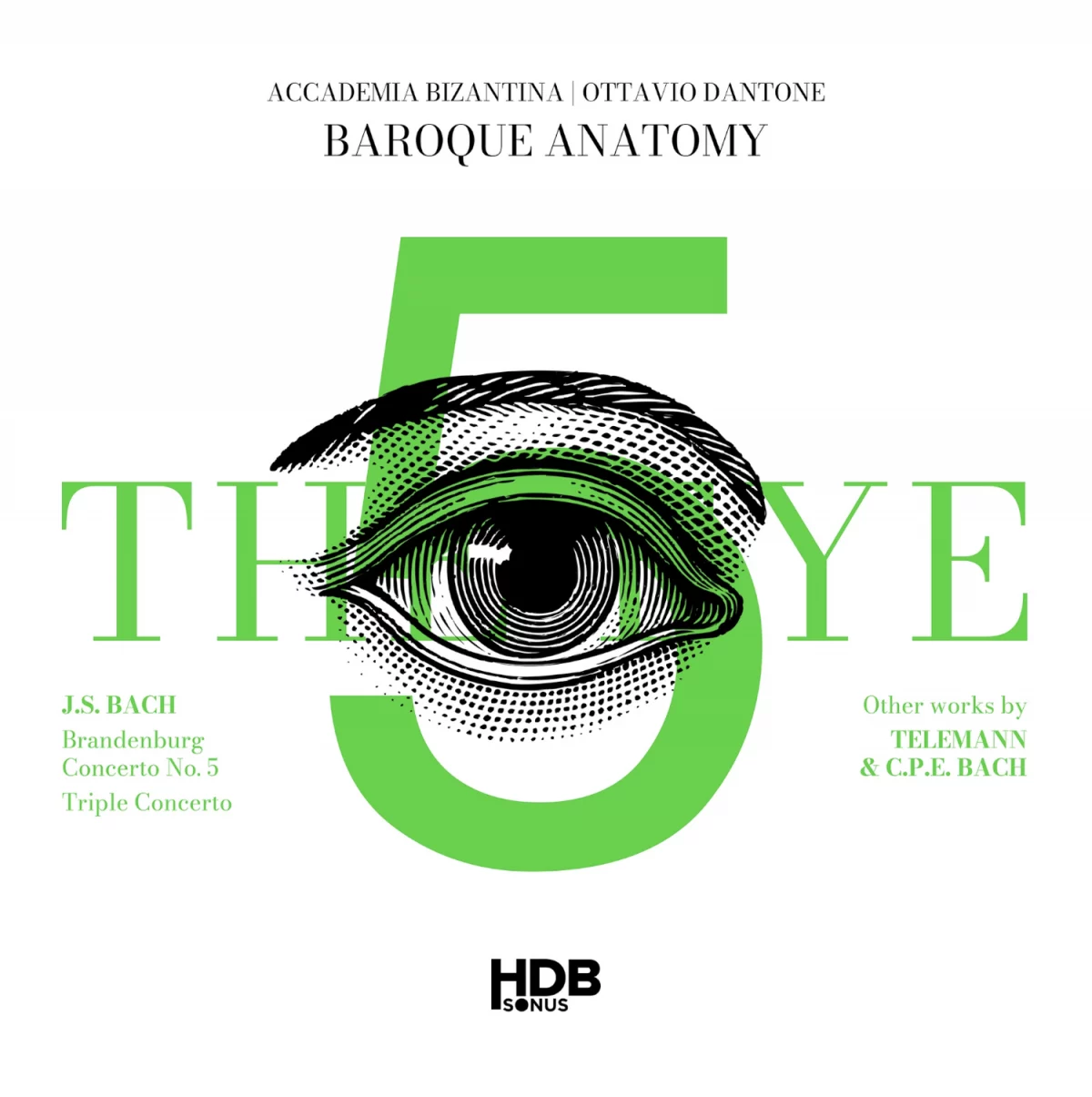
Marcello Gatti flute, Alessandro Tampieri, violin, Accademia Bizantina, directed by Ottavio Dantone harpsichord
65:23
HDB Sonus HDB-AB-ST-006
Behind the rather curious heading lies an intriguing project by the consistently innovative director of Accademia Bizantina. It involves the recording of Bach’s Brandenburg Concertos issued not as a set of all six in the usual way, but rather giving each a CD to itself and surrounding it with works by Bach or his contemporaries that have a connection in instrumentation or other reason. The anatomy part the title is a rather obscure conceit, the explanation for which I leave readers to discover from Ottavio Dantone’s notes if they buy the disc, which is so exhilarating that everyone ought to at least hear it, better still, own it.
To finish explanations, there should by now be no reason not to have worked out that the ‘5’ in the title tells us that the first Brandenburg to be featured is No 5 in D, BWV 1050. The obvious companion included is the Triple Concerto in A minor, BWV 1044, which features the same three solo instruments: flute, violin and harpsichord. Also closely related as to instrumentation is Telemann’s Concerto for Flute and Violin in E minor, TWV 52: e3. Finally Bach’s eldest son Carl Philipp Emanuel moves us from the Baroque to the galant with his Flute Quartet in A minor, Wq 93, a late (1788) work actually scored for just flute, violin and harpsichord (which plays two parts) that at least in its playful outer movements is surprisingly close to the spirit of the rococo for a minor key work by CPE. A more expected mood comes with the central Largo e sostenuto, which inhabits the profoundly expressive world of Empfindsamkeit so closely associated with CPE Bach. Described in the notes as having five movements, the Telemann E minor Concerto is more accurately in four movements, the extremely brief Adagio that links the third and fourth movements acting purely as a bridge. Its opening movement has no tempo indication and is indeed one of the few places where Dantone’s chosen tempo might be queried, it sounding rather peremptory at such a very brisk speed.
No such caveats arise with the Bach concertos. Dantone has long been an exceptional exponent of Bach’s instrumental music and both are outstanding performances, notable above all for his ability to achieve an excellent balance, every contrapuntal strand thus emerging with exceptional clarity. To outer movements can be added a buoyancy and at appropriate moments a quite delicious and irresistible lightness of touch – try the opening of the final Allegro of Brandenburg 5 for a fine example. In contrast, a movement like the central Affettuoso of the same concerto breathes an aura of ineffable tranquillity, its cantabile beautifully spun by the soloists who are not averse to subtle touches of additional ornamentation. Indeed, this is most likely the moment to stress that the playing of all three soloists is first-rate throughout. Dantone’s own contribution underlines his special credentials as a Bach interpreter, seizing his great moment – the magnificent cadenza at the end of the opening Allegro of Brandenburg 5 – with a display of supreme virtuosity that is always within the bounds of sheer musicality. At the other end of the scale, listen to the sweetly empathetic exchange between flautist Marcello Gatti and violinist Alessandro Tampieri, the long-time leader of Academia Bizantina, in the beguilingly lovely Adagio of the Telemann Concerto.
Whether or not you buy into Dantone’s concept for presenting a set of the Brandenburg Concertos, there can be no argument that it is a quite exceptional start to the series. These performances joyously live and breathe a mastery and musical virtuosity that is there to illuminate the music, not the performers.
Brian Robins