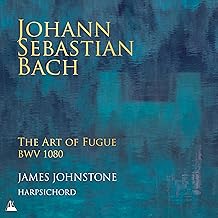
James Johnstone harpsichord (+ Carole Cerasi)
100:13 (2 CDs in a card triptych)
Metronome METCD 1111 & 1112
This is an amazing performance of The Art of Fugue (BWV1080) by the expert harpsichordist and organist, James Johnstone, with the assistance of Carole Cerasi, who often produces his recordings, and does so here when she is not playing a second harpsichord.
One of Johnstone’s gifts – central to his Bach recordings on the organ – is that of choosing the right instrument for the particular repertoire, and that is true of this performance of the Art of Fugue as well. He plays a 1995 copy by Stephan Geiger after an instrument by Johann Christoph Österlein of 1792. While this may sound anachronistic, it ‘shares significant characteristics with the instruments from Michael Mietke’s workshop, with which Bach was familiar’, he comments. It is certainly crystal clear, and has a mellow, bell-like sound: there are few harpsichords I would be happy to listen to for the unbroken 100 minutes these two CDs employ to record the whole work, but this was ideal for such an intense and concentrated performance. And its companion, lent by Trevor Pinnock, built by John Phillips in 2007 after a 1722 original by Johann Heinrich Gräbner the elder seems an excellent match for tracks 1, 2, 10 & 11 of CD2 which Carole Cerasi plays.
Johnstone has chosen to give us ‘the first integral recording of this posthumous 1751 print’, and it therefore concludes with the choral Wenn wir in höchstein Nöten sein played on the 1737 Treutmann organ in Grauhoff. And in listening to the whole Art of Fugue straight through, I was struck by how coherent it is, even if it might have been re-edited by Johann Sebastian in some details had he lived longer – there are signs that even as the plates were being prepared, he was tinkering with details.
There are, of course, many other performances available. For many years, I have been wedded to Fretwork’s take on a consort of viols, and there is one by Phantasm too; and both Jordi Savall in 2001 and Shunske Sato’s All-of-Bach version from 2001 use a wide variety of scoring. The first recording Johnstone bought as a teenager was by Lionel Rogg on the large organ of St Peter’s Cathedral, Geneva – and still to be found today. But for its clarity, intensity and depth of feeling this version is hard to beat, and I come away from the experience convinced that this is the best way to engage with such a deeply cerebral score, and mildly irritated by the apparent random assortment of instruments scored by Sato. The coherence of the developing depth of the individual variations, when those that are only in two parts suddenly feel as if they are in many more, reflects something that is true of the apparently simple solo sonatas for a single violin, where, around the apparently simple line of a single instrument, you suddenly hear the parts of a complete polyphonic structure. To test this, said his son-in-law, Bach would try out a piece for a solo instrument on a keyboard, adding just enough implied harmonic structure.
Something like this is what you get from this performance. It may seem deceptively minimalist, but Johnstone’s skill in pacing the canons as well as his unrivalled fluency in shaping the material shines through the textures with a clarity and inevitability which does more than justice to this towering work. I know of no better performance.
David Stancliffe
2 replies on “Bach: The Art of Fugue”
I will look forward to hearing this. Thanks very much for mentioning the instruments–not all reviewers do. My favorite performance of this work is Gustav Leonhardt’s recording for Deutsche Harmonia Mundi. Leonhardt was one of the first to contend that this work was written for harpsichord.
In all period instrument reviews, I try and note – though only performances on harpsichord or organ regularly give details – the instruments involved. Important for harpsichords, where both the builder and the historical model are regularly listed, but vital in the case of the organ, especially when it is a historic instrument in its original context.