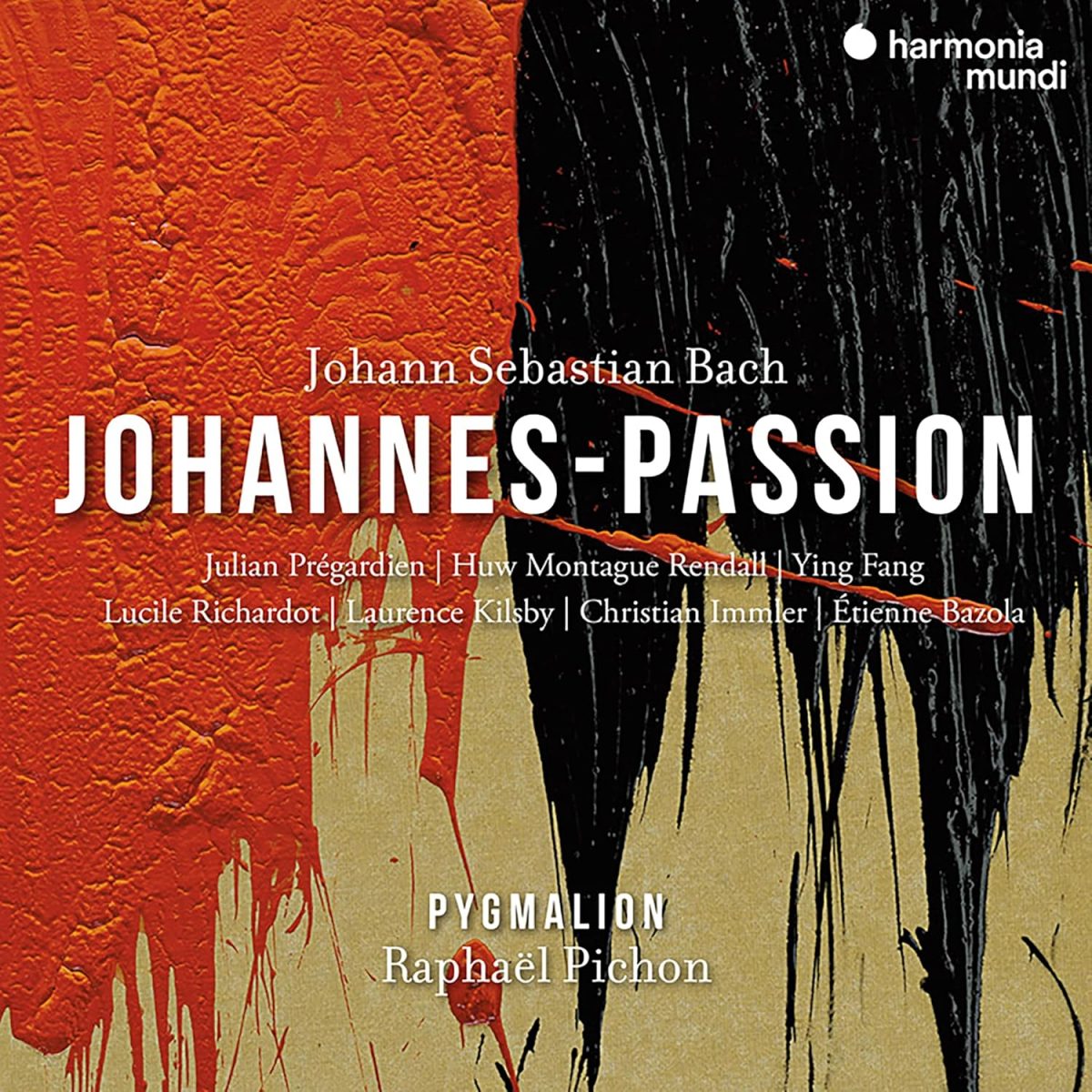
Julian Prégardien Evangelist, Huw Montague Rendall Jesus, Ying Fang, Lucile Richardot, Laurence Kilsby, Christian Immler, Etienne Bazola, Pygmalion, Raphaël Pichon
115:00 (2 CDs in a box)
harmonia mundi HMM 902774.75
This performance of the Johannes-Passion has everything: it has Julian Prégardien on fine form as the Evangelista, and a fine operatic baritone (new to me) – Huw Montague Rendall – as Jesus, as well as starry singers like Lucile Richardot and Christian Immler in the line-up. It has the violas d’amore and theorbo of the 1723 version, and the bassono grosso of the last. It has a complex continuo scoring involving cello, double bass, theorbo, harpsichord and organ – a quite substantial instrument with at least principals 8’, 4’ and 2’ rather than the usual little box organ based on an 8’ stopped flute: but we are given no details of this instrument (which I suspect is at some distance from the main body of the performers). This leaves Pichon free to vary the continuo line where (in the Evangelist’s recitative at least) the sonorous double bass is a constant at 16’.
The soprano aria Ich folge has just the ’cello and theorbo, and the agile yet mellifluous tenor Erwäge the theorbo likewise, with, I think, the harpsichord sometimes as well. These, and Huw Montague Rendall’s Betrachte, are beautifully sung as are the arias in Part II: Richardot’s Es ist Vollbracht has that out-of-this-world tone which makes her such a striking interpreter of texts like this, and Huw Montague Rendall has the lyrical depth to give us a matchless Mein teurer Heiland – not too jaunty and hurried but with that hint of a D major resurrection in the moment of death. Not everyone will like the underlying philosophy that the singers in the arias are accompanied by the instruments rather than equal partners with them, as Zerfliesse reveals most clearly.
The splendidly drilled choir of 6.4.4.5 (a little light on alto tone) always sings separately from the six principal singers; it is miked independently so that the balance between choir, orchestra (5.4.3.1.1 strings) and soloists can be balanced artificially. All this, of course, is standard recording practice, and makes for a fine dramatic whole, which Raphaël Pichon in his liner notes spells out in his enthusiastic way, showing that he understands Bach’s take on the theology of St John’s passion gospel: The hinge-point choral Durch dein Gefängnis is sung pianissimo and unaccompanied to make the point. But when every moment of the Evangelista’s narrative is milked for its drama, then we start to suffer overkill.
Is this a conception that Johann Sebastian would recognise? Most disconcertingly for me, the exchanges between the Evangelista and the turba are between people on different planets: However sharply the turba sing and however beguiling the Evangelista woos them into his story, they yield two different sound worlds. This will be true of all performances in which the singers are divided in the modern way into being either soloists or members of the choir. This performance contradicts – as do many modern takes on the Johannes-Passion – not only what we know about how Bach conceived his music but also about how it was received. Bach’s principal singers were the basic chorus – the core participants in his Passions – to which others were added. It was emphatically not like opera, a spectacle out there with distinct roles at which we, the distant spectators, marvelled. It is we who are the participants: We are both the agents of the drama and at the same time the worshippers in church on Good Friday. A performance of the Johannes-Passion that strives for the pinnacle of excellence in its individual components may fall down on the one thing that is absolutely essential – the interconnectedness of the individual parts to the whole.
Listeners need to make up their own minds about performances like this, which many will admire and assume that this is just what Bach would have wanted. It will fill concert halls and sell the CDs. But for me, the central factor – the integrity of the whole – is missing.
David Stancliffe